Why venture capital is still constrained by geography
/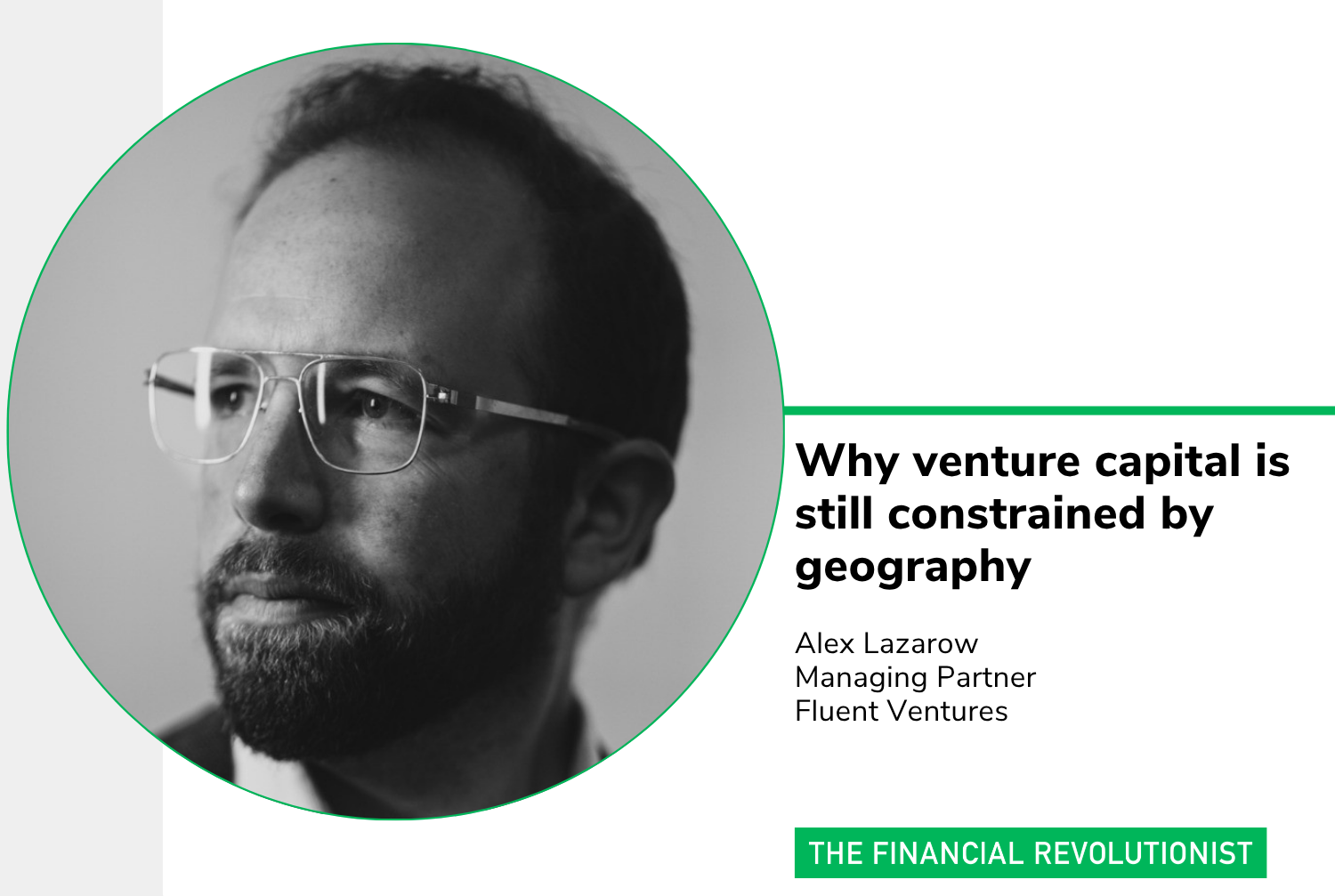
Alex Lazarow is an author, speaker, global venture capitalist and contributor to The FR.
In the final days of SuperReturn in Berlin this summer, SpaceX priced the largest IPO in history, raising $75 billion at a valuation near $1.75 trillion. Its market value later exceeded $2 trillion. I had spent that week in Berlin and the previous week at South Summit in Madrid.
For a decade, I have argued that talent is global and capital is provincial. Recent conversations have sharpened that point: Tech has globalized, but the money has not yet caught up.
Talent has gone global, and AI is accelerating it
Europe’s startup ecosystem illustrates how widely entrepreneurial talent has spread. It’s now worth roughly $5.6 trillion, larger than several of the continent’s own public markets, according to figures presented by Annie Hamill of Adams Street in her SuperReturn keynote, “State of Global Venture 2026.” A record 27,000 founders started European companies in 2025, and there are more than 200 unicorns in Europe today.
By comparison, when I started investing in venture in 2013, the term “unicorn” applied to a small club of companies that was almost entirely American.
Michael Collins of Alumni Ventures noted that there are great founders everywhere, and the Bay Area holds no monopoly on grit or vision. People still move there, but the diffusion is real and accelerating. Alexander Schmitt of Lightspeed pointed to European companies emerging as category leaders, with ElevenLabs in voice and Legora challenging Harvey in legal. Importantly, he argued that the old valuation ceiling has been lifted: Companies on the continent can now build past the $10 billion mark that used to cap their ambition.
The money hasn’t followed
More than 90% of venture dollars now go to AI-native companies, according to Adams Street, and the overwhelming share sits in a handful of U.S. names. It’s been well documented that value is pooling in a few private giants worth hundreds of billions each. Because of the ever-present power law, returns come from a thin tail of outliers, and for now, allocations are piling into those companies, which are still largely in the U.S.
LPs are looking for exits
A key theme is liquidity, or at least the desire for it. Venture distributions in 2025 ran at about half their 46-year average. Fewer than three dozen U.S. tech companies went public last year, down from more than 120 four years earlier.
A majority of venture funds now take 14 years or more to fully wind down, and the time it takes a company to go public has risen from roughly four years in the late 1990s to 12 today.
The industry has rebuilt the plumbing. Secondaries have become a structural solution. By figures cited on stage, around $20 billion of venture liquidity now flows through them, close to a third of the total. Continuation funds, long a private equity instrument, are migrating into venture to crystallize value that has nowhere else to go.
The exit environment appears to be improving. SpaceX went public, OpenAI and Anthropic have both filed confidentially to follow, and Adams Street put the value of potential IPOs over the next 12 months at more than $4.2 trillion, including SpaceX.
That is on the order of Germany’s GDP and roughly double the entire prior decade. In August, SpaceX completed its $60 billion acquisition of Cursor, the largest acquisition of a venture-backed startup on record.
But look at where the value sits: SpaceX, OpenAI, Anthropic, Cursor, Cerebras and Databricks. A handful of trophy names does not amount to a broad market reopening. Yes, the door has cracked open for companies everyone already knows. But for the roughly 24,000 other venture-backed AI companies, and for the funds holding aging positions, the math has not changed.
Broad trends are evolving rapidly
Three other trends popped out again and again.
First, AI is collapsing the cost of building, which lowers the barrier to scaling anywhere. This was a throughline of “Building Outliers: Scaling Companies in the AI Era,” a panel I joined at South Summit in Madrid alongside JC Glancy, co-founder of ZenBusiness and, more recently, Candosa. ZenBusiness was a portfolio company at a firm where I previously worked, while Candosa is a current Fluent Ventures portfolio company.
Entrepreneurs in emerging ecosystems can get to early product-market fit with limited capital and reach profitability much earlier. We call this camel seed-strapping. What it means is an increasingly global distribution of innovation.
Second, the AI roll-up trend in the U.S. is scaling globally and may actually outstrip its U.S. counterpart. The services industry that AI can attack is worth more than $15 trillion, dwarfing the software market that venture has historically funded. The strategy of rebuilding fragmented professional services at the AI layer is real, and American capital is already crowding into it.
Not every roll-up clears the bar. The ones that work need real margin expansion and plentiful, affordable targets, as I have argued. The deeper risk, repeatedly cited at both conferences, is commoditization. When the model is the only edge, an open-source release erases it, so the moat has to be proprietary data and workflow. That’s where geography helps. In the U.S., a hundred funded teams chase each category. In most other markets, far fewer do.
Third, the opportunity is also a responsibility. Will Porteous of RRE pointed out that venture sits at the far edge of the risk spectrum and that this position carries responsibility because “what gets funded gets built, and what gets built can change everything.”
I would push it one step further from a geographic perspective. If talent and adoption have gone global, and the cost curve has followed, then deploying the overwhelming majority of venture capital within a 50-mile radius is a choice, not a law of nature. The encouraging part is that responsibility and returns point in the same direction: The underserved problems and the least-crowded entry points are increasingly found in the same places.
The founders have gone global. So has adoption, and so has the cheap compute that now lets a few engineers in Lagos or São Paulo build what once took a hundred in Mountain View. Capital is the last input still behaving as if geography were destiny. For the allocators who nodded along during multiple panels, the question is: What, exactly, are they still waiting for?
This article was adapted from a piece originally published in Forbes.