The commercial card's new role in agentic commerce
/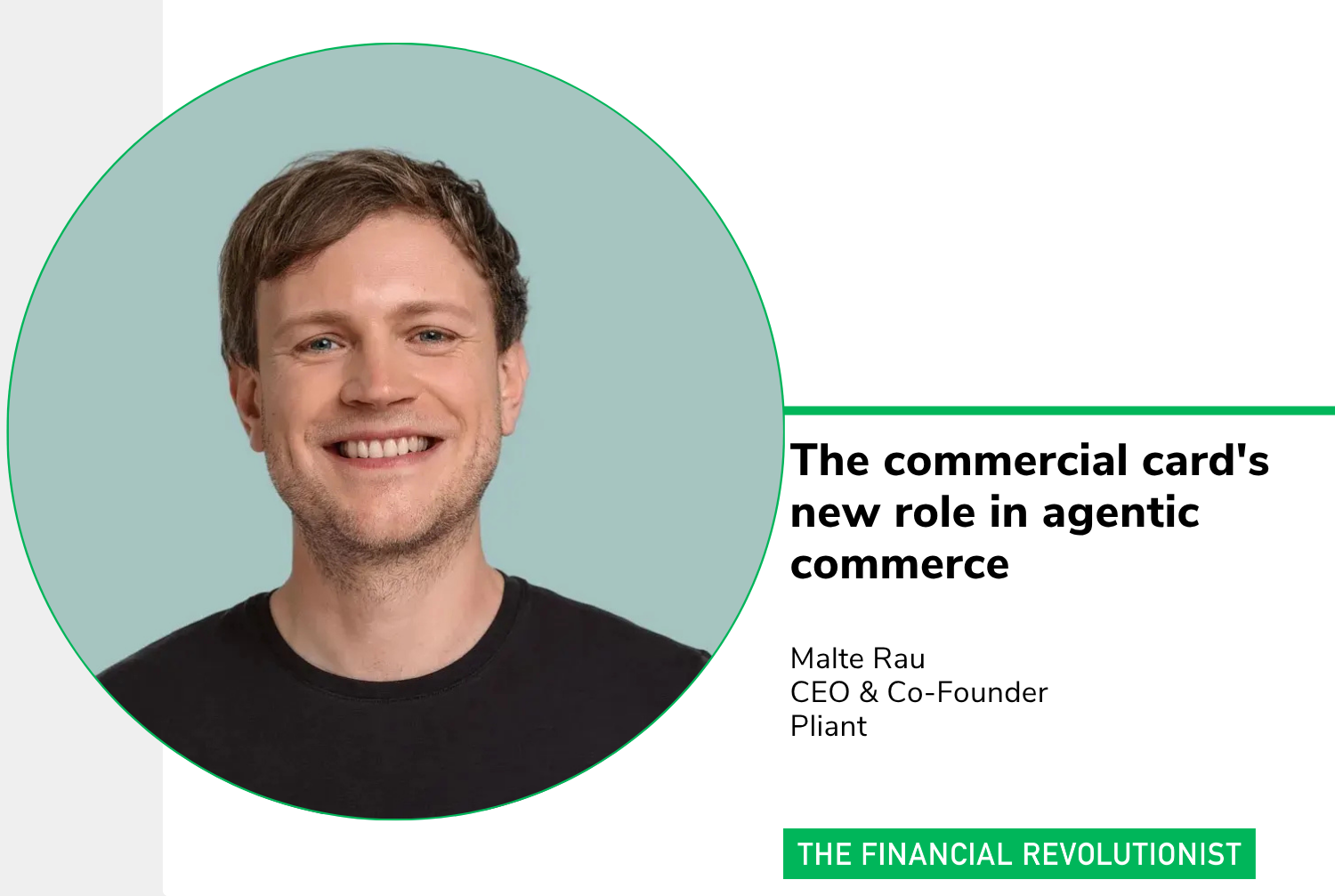
Malte Rau is CEO and co-founder of Pliant, a modular B2B payments platform that combines card issuing and spend management.
Much of today's discussion around agentic commerce centers on consumer shopping. Can AI buy groceries? Can AI book travel? How does a merchant know whether a human or an AI agent made the purchase?
Those are important questions in the context of consumer payments, where the purchase itself is the primary event. However, when assessing the potential for agentic payments in a B2B context, we need to consider an entirely different set of questions.
For businesses, payment is rarely the beginning of a transaction. More often, it follows an approved purchase order, an invoice, or another established business process. By the time payment occurs, the merchant’s priority is receiving funds. At the same time, the business is managing a much broader workflow that includes approvals, accounting, reconciliation, reporting, tax treatment, and auditability.
B2B agentic commerce will require AI to operate within the same approval, spending and reporting controls that govern employees today. Commercial cards provide that infrastructure, allowing businesses to delegate spending authority without sacrificing visibility or accountability.
From individual purchases to automated workflows
Agentic commerce is therefore as much a governance issue as a payments issue. Businesses already understand how to delegate spending authority. The challenge is extending those same governance principles to AI agents without losing control, visibility or accountability.
Delegating spending authority is nothing new. Organizations already authorize employees, departments, and teams to make purchases within defined budgets and policies. The arrival of AI agents does not require businesses to invent new payment methods. Instead, businesses can apply the financial controls they already use for employees, departments and teams to a new kind of participant in the workflow.
As agents take on a role in financial workflows, the instructions businesses give them will evolve as well. Today's AI interactions are largely task-oriented. A user tells an agent exactly what to buy, how much to spend, and where to make the purchase. Over time, in a B2B setting, those interactions will become increasingly workflow-driven.
Instead of instructing an agent to purchase a laptop, for example, a manager will simply tell the system that a new employee starts next Monday and the workflow will unfold automatically. The system procures the laptop, completes the purchase, reconciles the expense, and updates the appropriate finance systems. The payment becomes one step within a broader business process.
Why commercial cards are built for agentic commerce
The practical question is what will give businesses the confidence to delegate spending authority to an agent. This level of control is difficult to replicate with traditional account-based payment methods. Commercial cards, however, already provide the programmable controls businesses need to delegate spending with confidence.
The capabilities that make commercial cards well suited for agentic commerce are not new. Virtual cards, configurable controls, and programmable spending policies have existed for years and are already widely used in many industries. Those same capabilities become increasingly valuable as AI begins participating in financial workflows.
As AI becomes embedded across procurement, IT, finance, operations, and other business functions, those same capabilities become relevant across a much broader range of industries and use cases.
The opportunity for banks is to make existing card infrastructure more flexible, programmable, and accessible to businesses that are beginning to automate purchasing workflows. Institutions that have already invested in programmable commercial card infrastructure will be well positioned to support the next generation of AI-enabled financial workflows.
That brings us back to the distinction between consumer and business agentic commerce. Businesses need an agent to go beyond completing a purchase and allow it to participate within a trusted financial workflow. As AI takes on a greater role in business purchasing, organizations will place even greater importance on trust, governance, and accountability. Businesses will measure success by how confidently they can delegate spending authority within established financial controls.
Commercial card infrastructure is already built on these principles. Programmable controls, virtual cards, approval policies, and auditability provide the foundation businesses need to safely incorporate AI into financial workflows. The next phase of agentic commerce will reward banks and payment providers that make those systems more flexible, configurable, and capable of supporting AI-driven workflows.