AI agents are forcing a rethink of payment rails
/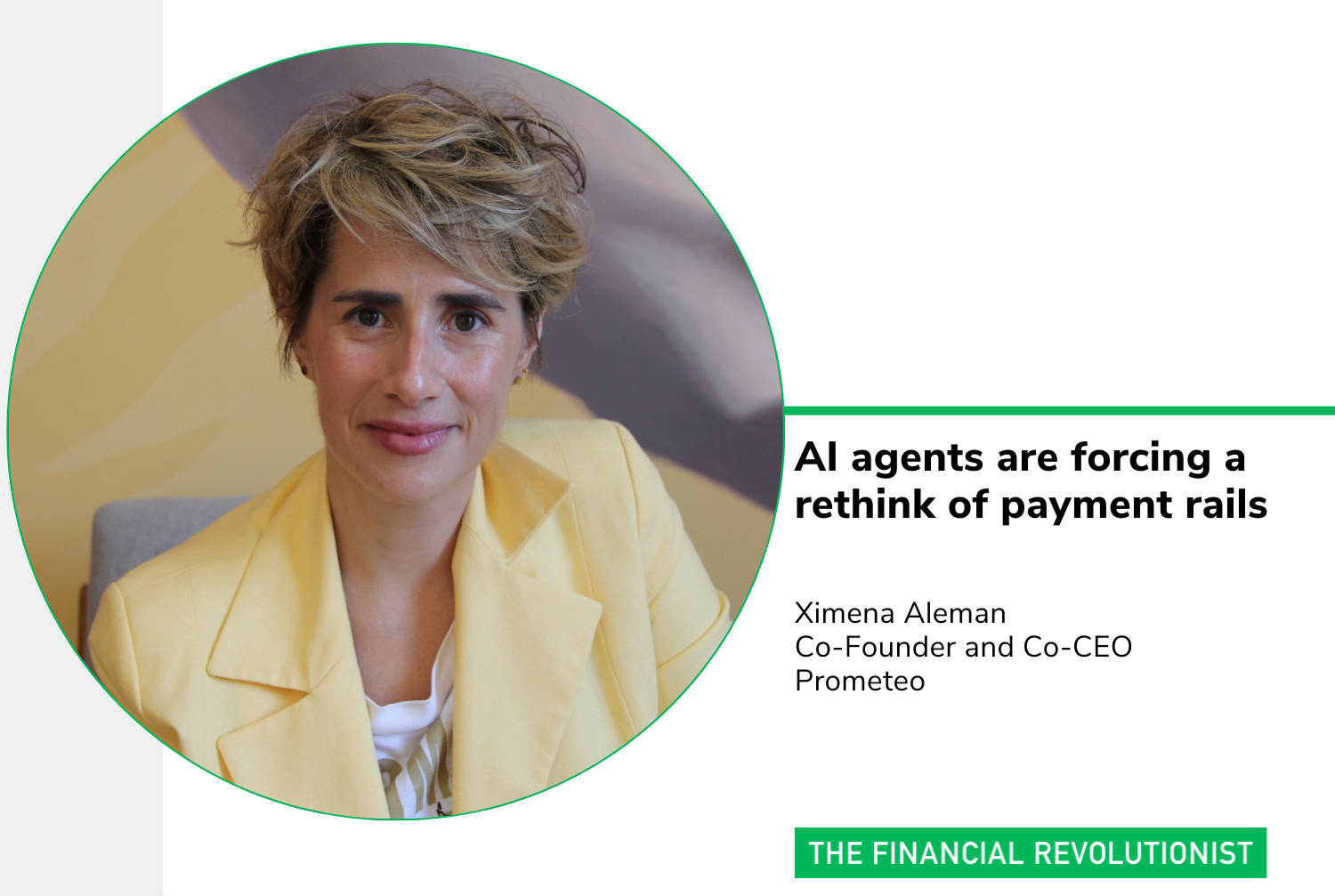
Ximena Aleman is co-founder and co-CEO of Prometeo, a fintech infrastructure company focused on banking and payments connectivity across Latin America.
As artificial intelligence begins to initiate payments autonomously, the infrastructure beneath it will determine who can participate.
If agentic payments are built exclusively on credit card rails, they will automate convenience for those already included and friction for everyone else. That outcome is not inevitable. Built on lower-cost, accessible infrastructure, agentic payments could scale capability instead of inequality.
In 2025, AI in financial services crossed a threshold: systems are moving from advising to acting. Agentic AI can authenticate, decide, and initiate transactions in production environments. As these systems begin to execute payments directly, the underlying financial architecture becomes more important than model performance.
The next phase of AI-driven commerce will depend less on the intelligence of the agents themselves and more on whether the payment rails beneath them expand financial participation or reinforce existing barriers.
Credit cards can’t be the default rail for agentic payments
Much of the early momentum reflects a U.S. financial fact. Credit cards are the default rail of commerce. As a result, many agentic payment initiatives are designed to fit existing card-based checkout flows. OpenAI’s “Instant Checkout” inside ChatGPT, powered by Stripe and introduced with U.S. merchants, is an early example.
If AI is a multiplier, agentic payments will amplify whatever the financial system already rewards. This is a pivotal moment. These systems can widen the gap between developed and emerging markets, or help close it. The difference lies in whether they are built on rails that are accessible by design.
The stakes are particularly high in Latin America, where the financial architecture looks very different. In the United States, credit cards are deeply embedded in everyday commerce; 81 percent of adults had one in 2024. In Latin America, ownership is lower and unevenly distributed, especially among micro-entrepreneurs and lower-income consumers. Even where cards are present, cash and alternative payment methods dominate daily transactions.
Much of the early agentic payment narrative assumes users can simply “pay.” In practice, that often means pulling a card. But in Latin America, millions participate fully in the economy without one. They pay suppliers, receive wages, run small businesses, and move money through bank transfers, real-time payment systems, and digital wallets.
Building agentic payments on credit card rails carries different risks depending on where they are deployed. In emerging markets, this approach extends infrastructure that has historically excluded base-of-the-pyramid consumers and micro-entrepreneurs, often at cost structures they cannot absorb. In the United States, the exclusion looks different. Enterprise and mid-market sectors frequently rely on bank rails for large-value transactions where cards are inefficient. In both cases, defaulting to card infrastructure does not modernize payments. It automates existing fault lines.
Brazil’s Pix shows what a different path could look like
Brazil’s Pix offers a glimpse of an alternative path. Pix is now Brazil’s dominant payment method, processing more than $4.6 trillion in transactions in 2024. In June 2025, the Central Bank launched Pix Automático, enabling recurring payments through single consent without requiring a credit card. Subscriptions and utilities no longer default to card-only billing. The infrastructure expanded participation first; innovation followed.
Brazil also highlights what the broader region lacks: a shared framework. Across Latin America, fragmented standards for real-time payments and open banking have forced markets to solve the same problems repeatedly, preventing the region from leapfrogging as a bloc. In an agentic economy, fragmentation is not just a policy issue. It becomes a product constraint, and autonomous systems will encounter it at scale.
Moving agentic payments onto real-time, account-to-account rails also raises questions no chatbot can answer. Who granted consent? How is it enforced? How are identity and accounts verified? What happens when the agent is wrong? How are actions audited?
In push-payment systems, trust is infrastructure. Agentic systems are only as safe as the controls beneath them: verification, monitoring, dispute resolution, and clear accountability. With real-time rails and consent-driven frameworks in place, however, the agentic layer becomes far more powerful than AI-enabled checkout. It can manage cash flow for small businesses, reconcile invoices, optimize working capital, and route payments through the fastest and most cost-effective path. In practice, that turns agentic payments into a financial operating layer for the long tail of merchants and micro-enterprises that have historically lacked access to sophisticated financial tools.
The business case reinforces the access case. McKinsey reports that banks applying agentic AI in frontline domains can lift revenue while reducing cost to serve. Inclusion and efficiency are not competing goals. When infrastructure is designed well, they reinforce one another.
A parallel shift is unfolding with the rise of stablecoins, effectively creating two financial rails. One is the traditional fiat infrastructure the banking system has relied on for generations. The other is a stablecoin rail emerging as a powerful layer for cross-border money movement.
Today, these remain largely separate systems. Interoperability, beginning with practical on-ramps and off-ramps, is what turns parallel rails into meaningful new use cases. In Latin America, that matters because stablecoins are often adopted in response to currency volatility, while domestic commerce continues to rely on real-time payment systems. Agentic systems built on interoperable banking rails can bridge those environments without making credit cards the gatekeeper.
Agentic payments shift decision-making closer to the infrastructure layer. As AI systems initiate transactions, manage liquidity, and route funds autonomously, the rails beneath them will determine who gains leverage and who faces new barriers.
For Latin America, the opportunity is still open, but it will not remain open by default. If the next chapter of AI in finance is to be about access and development rather than the automation of inequality, we must build on rails that reflect how the region actually moves money and align on standards that allow agentic payments to scale across markets.
The future of agentic payments will not be decided by the intelligence of the models alone. It will be decided by the infrastructure we choose to power them.