Why stablecoins need a trust layer
/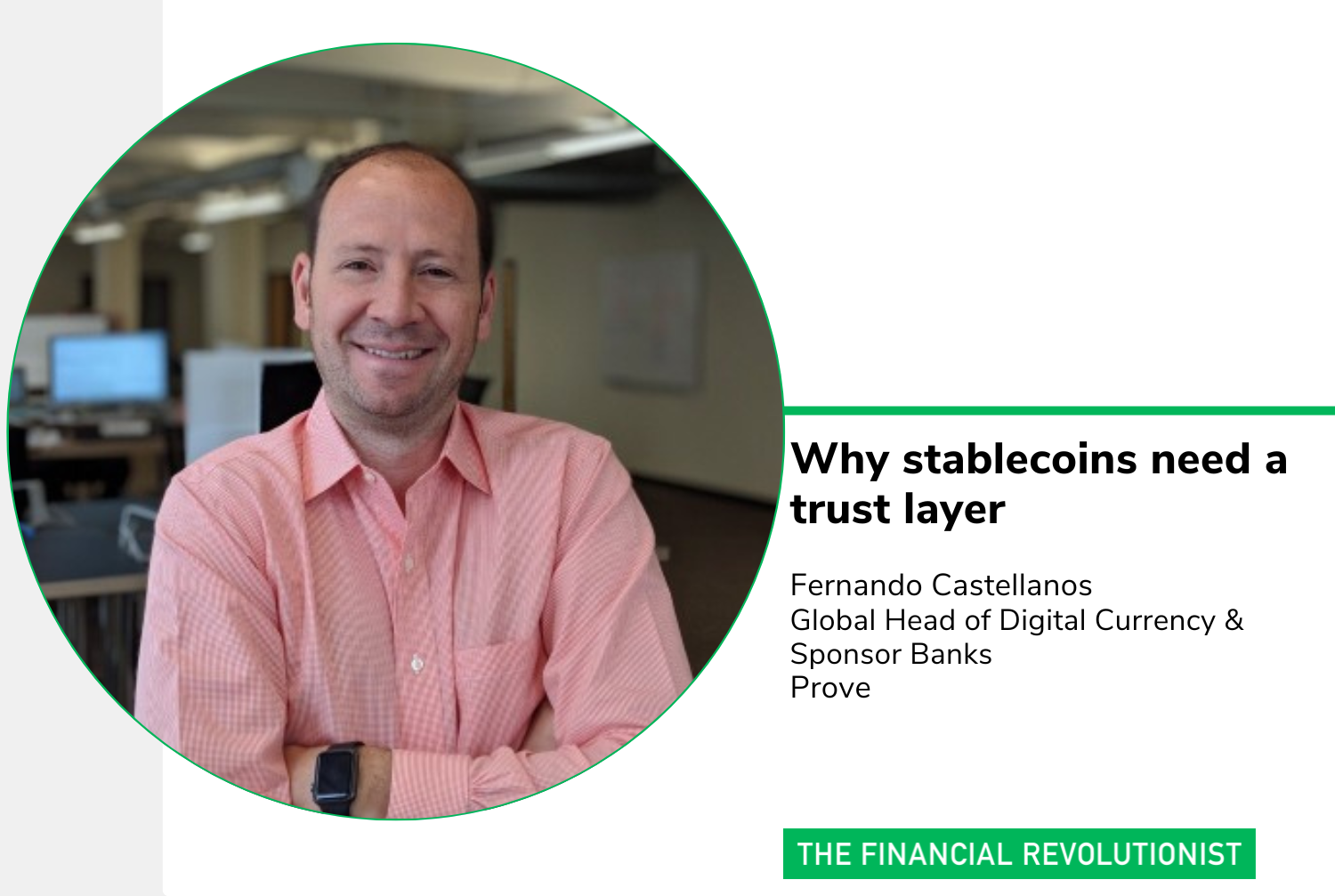
Fernando Castellanos is global head of digital currency and sponsor banks at Prove, an identity verification company. The FR spoke with him about stablecoins, trust and the future of digital payments.
Why has enterprise interest in stablecoins accelerated so dramatically over the past year?
We’ve not only seen interest in stablecoins from enterprises increase, but we’ve also seen it shift from exploration to actual implementation. Regulatory frameworks like the GENIUS Act and MiCA have legitimized stablecoins as a means for money movement and have given enterprises the regulatory clarity they need to commit capital and build with peace of mind.
Financial institutions are realizing that the cost of implementing and piloting digital asset strategies far exceeds the cost of inaction. Cross-border payment fees average 6–7%. They have a two- to five-day settlement window, and show persistent liquidity inefficiencies. If you do the math, you’ll see there is really one right answer.
The real catalyst is growing confidence that stablecoins can operate within enterprise-grade risk and compliance frameworks. The question has shifted from whether to explore stablecoins to how to deploy them safely, and at scale.
In order for stablecoins to truly succeed, there needs to be a trusted identity infrastructure behind it, and the industry recognizes that. As with any new payment innovation, it can’t mature into the mainstream without widespread trust; enterprises want to be confident in the identity behind it. Establishing that trust at onboarding, sustaining it through authentication, and continuously managing risk have become prerequisites for adoption, not afterthoughts.
Are stablecoins primarily a technology innovation, or an identity and trust challenge?
I would argue that they're both, but the larger challenge is trust.
We’ve had the technology to move value on-chain for years, that’s nothing new. The real problem is ensuring, without a doubt, that the individuals and businesses participating in those transactions are who they say they are.
Ultimately, every financial innovation faces the same question: How can participants be sure who they’re transacting with?
In order to answer that question, enterprises need to start viewing stablecoin adoption through the lens of trusted identity. Enterprises need to find a way to be confident that customers, counterparties, and wallet holders are who they claim to be, without creating friction that drives them away.
Identity verification, authentication, fraud prevention, and continuous trust are what make blockchain innovation functional in real-world financial systems. That balance between rigorous compliance and seamless experience is difficult to get right, and it’s where most programs struggle.
Without trust, scalability becomes impossible.
What risks are enterprises underestimating as they accelerate stablecoin adoption?
Organizations are aware and focused on the risks that are immediately visible to them, such as market, liquidity, and regulatory risks. It's the later-stage risks, such as those related to identity, that can be easily missed or underestimated because they don’t become a real issue until a stablecoin program scales.
Fraudsters are consistently among the earliest adopters of new payment rails. We’ve seen this with ACH and real-time payments, so it's safe to assume stablecoins will be no different. As stablecoin usage grows, so do the risks via account opening fraud, synthetic identities, account takeover, mule account activity, and increasingly sophisticated social engineering. The irreversibility of on-chain transactions makes each of these threats more consequential than on traditional rails.
Organizations also underestimate the operational challenge of retrofitting existing compliance controls to new transaction environments. Controls designed for batch settlement don’t map cleanly onto real-time, irrevocable blockchain transactions. Even enterprises that understand this often find their fraud teams playing catch-up once a program launches. A fast settlement network only creates value if risk teams can identify bad actors before funds move, not after.
In order to successfully and securely adopt stablecoin usage, enterprises have to take the offensive by moving from reactive transaction monitoring to preventative trust controls. The strongest programs establish high confidence in identity at onboarding and sustain that confidence throughout the customer journey. On blockchain rails, post-transaction investigations often come too late.
Could sponsor banks become the gatekeepers of stablecoin growth, and what will they be looking for before supporting these programs at scale?
Sponsor banks hold the key to widespread stablecoin adoption since they handle regulatory compliance, risk management, and consumer protection. Before getting on board at a larger scale, banks will look for solid ground in a few spots: robust customer ID and verification, effective fraud prevention and account security, comprehensive AML and sanctions programs, strong governance and risk management, and provable auditability and transparency. As identity assurance and trust become a big selling point, banks will favor partners showing strong verification and authentication capabilities. Establishing who’s behind each wallet or account will be crucial for earning their support.
How should organizations balance innovation with compliance as they incorporate stablecoins into their payment and treasury operations?
Enterprises often view compliance as an obstacle to innovation, but it’s actually an enabler. The companies moving fastest aren’t avoiding compliance; they’re embedding it from the very beginning.
This is called a "trust-by-design" approach, building processes like identity checks, fraud prevention, and other compliance measures right into their product flows from day one. This makes the experience smoother for authorized users while still maintaining strong risk controls.
The goal is to build infrastructure that supports both growth and compliance simultaneously.
What role will regulation and compliance frameworks play in accelerating or slowing enterprise stablecoin adoption?
Clear regulations will speed up adoption. Historically, it's not the rules themselves but the uncertainty surrounding them that held back enterprise investments, such as the progress on the GENIUS Act in the U.S. and MiCA in Europe, which are shifting that equation for the better. Businesses typically step up when there are defined rules; they just want things to be consistent and predictable.
As these regulatory frameworks mature, companies will feel more secure about investing in stablecoin infrastructure long term. Clearer expectations set for compliance, consumer protection, reserve management, and reporting will encourage financial institutions, fintechs, and global enterprises to release new products.
We see identity and compliance systems becoming crucial for the future of digital payments. Having robust trust infrastructures in place lets everyone involved move ahead confidently.
What does the future of enterprise stablecoin adoption look like, and which use cases do you expect to drive the most growth?
We anticipate adoption moving from niche uses to core financial infrastructure.
The best near-term growth areas include cross-border payments and remittances, treasury and liquidity management, supplier and vendor payments, marketplace payouts, and real-time settlement between institutions. Global commerce and embedded finance experiences are growing, too.
As use expands, the line between traditional payment systems and blockchain ones won't matter as much to users. Customers will expect their finances to be faster, cheaper, and more transparent.
To succeed, companies need to blend payment innovation with secure identity infrastructure. It's not enough to be speedy; organizations have to build trust at every touchpoint as well.
What should enterprise leaders be doing today to prepare for a future where stablecoins are a mainstream part of global commerce?
The winners in this game are already making moves on three fronts.
First, they know where to spot stablecoins adding real value in business, like in cross-border payments, managing treasury operations, and streamlining settlement processes. But they stay away from just chasing the tech for its own sake. Instead, they look for cases that show clear improvements in either cost or speed.
Secondly, they're weaving trust and compliance directly into payment innovation, not trying to bolt it on after the fact. ID verification, security, and risk control should be treated seriously. This is where we see programs consistently underinvest, resulting in them failing to scale.
Of course, successful teams pick smart partners that understand both sides of the equation. The future winners will be organizations capable of delivering seamless customer experiences while meeting institutional-grade trust and compliance standards, and they won’t get there alone.
The future of digital commerce depends on trusted identity. As stablecoins become more mainstream, organizations best positioned for success will be those that can confidently answer the most fundamental question in financial services: Can I trust the person or business on the other side of this transaction?