Mortgage lenders move from AI pilots to proving ROI
/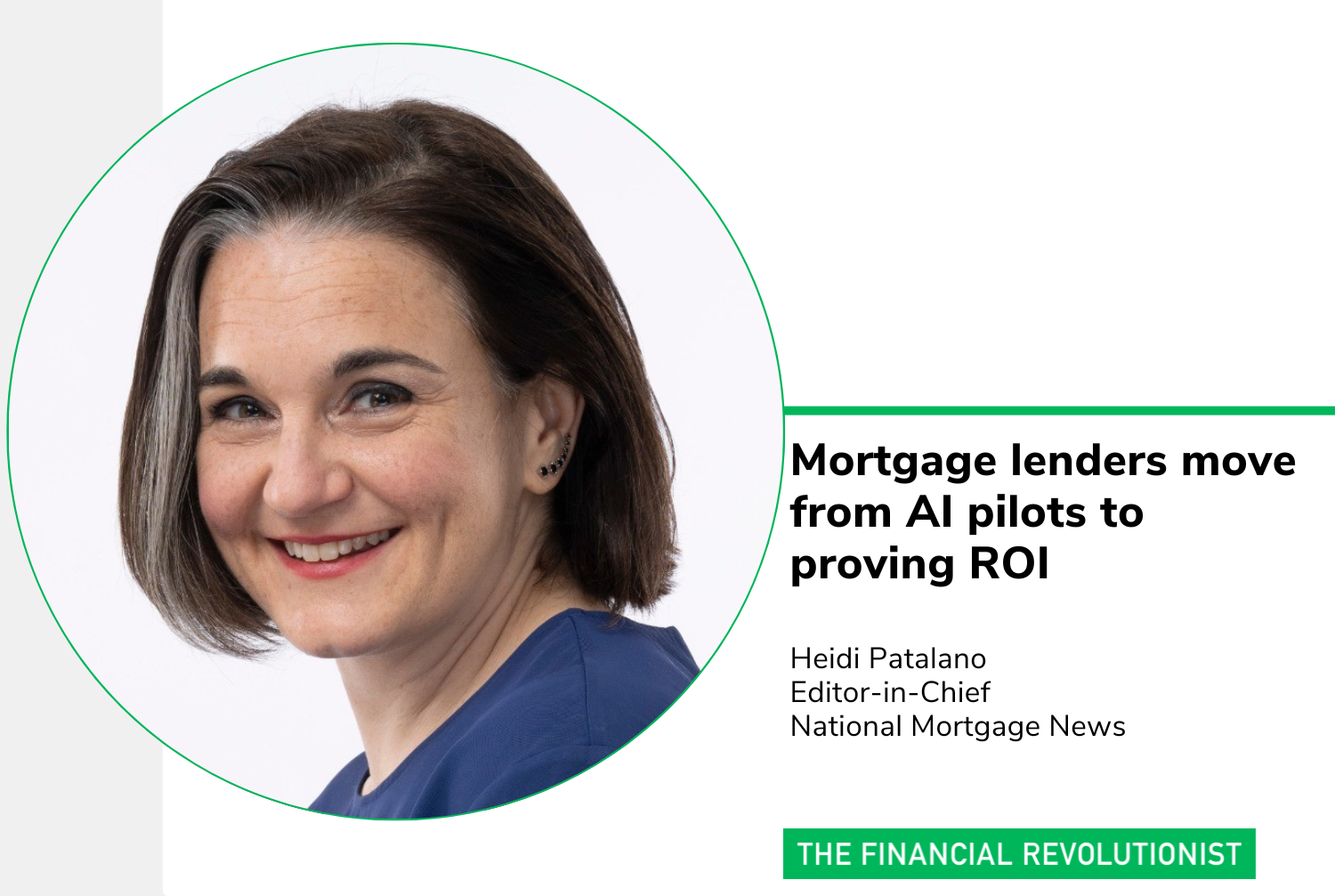
The FR sat down with Heidi Patalano, editor-in-chief of National Mortgage News, to discuss the state of mortgage automation and what to expect at Digital Mortgage 2026, taking place Sept. 14–16 in Las Vegas.
You're organizing Digital Mortgage 2026 at a critical time for the industry, as lenders confront affordability pressures, intense competition and rapid advances in AI. Why is this year's conference particularly important, and what will mortgage leaders gain from attending?
The framing we kept coming back to while building this year's agenda was simple: the era of experimentation is over. Strong execution is now the competitive advantage.
For three or four years, "we're piloting something" was a perfectly respectable answer at a conference like ours. It isn't anymore. Boards are asking what the pilots returned. CFOs are asking why the technology line item grew while cost-per-loan didn't move. And the gap between lenders who have operationalized this work and lenders who haven't is starting to show up in the P&L.
So we programmed this year around a single test: can the person on stage tell you what actually happened? Not the vision, the outcome. What broke. What it cost. What they'd do differently. Sessions like "Show Me the ROI: Proving Results From AI Projects" and "AI in Action: From Rollout to Reality" exist specifically because the interesting conversation in 2026 isn't about capability — it's about the distance between capability and successful adoption inside a real organization with real legacy systems and real people who are nervous about their jobs.
What leaders should gain is calibration. You leave knowing whether your roadmap is ahead of the market, at it, or behind it — and that's very hard to get from a vendor deck or a webinar.
Mortgage lenders have spent years investing in digital transformation. Where has that investment been delivered, and where is the mortgage process still stubbornly analog?
Where it has clearly delivered is data capture at the start of the process with a new borrower. Direct-source income and asset verification, document classification, automated indexing — that work is largely done at scale now, and it removed a genuinely miserable part of the borrower experience. The document chase used to define the first two weeks of mortgage production. At a well-run shop, it mostly doesn't anymore. Point-of-sale is table stakes. Automation in some of the underwriting process has absorbed a meaningful share of condition clearing.
Where it's stubbornly analog is everywhere the transaction touches a third party the lender doesn't control.
Title and settlement is the clearest example. eClosing and remote online notarization have been legally viable in most of the country for years now, and the technology works. Adoption remains uneven — not because lenders don't want it, but because it requires the title agent, the county recorder, the settlement attorney, the investor and the borrower to all be ready on the same file. Any one of them says no and you're printing paper. Appraisal and collateral valuation has similar friction. So does anything involving a county records office.
The other stubbornly analog thing isn't a process at all — it's the internal handoff. A lot of lenders have digitized individual steps and then bolted them together with a human who copies data from one system into another. The borrower sees a modern application. Behind it, someone is reconciling three systems of record by hand. That's where a lot of the remaining cost sits, and it's much less fun to talk about than AI.
AI is attracting enormous attention, but lenders are under pressure to show a return on their technology spending. Where is AI producing measurable results in the mortgage business, and where does the hype still exceed the reality?
Measurable results, in roughly descending order of confidence:
Document and data work. Classification, extraction, and validation of borrower documents. This is unglamorous and it works. It's also where the clearest per-file savings show up.
Condition clearing and pre-underwrite. Lenders are using AI to overlay guidelines against a file and effectively pre-condition it before an underwriter touches it. That compresses cycle time in a way you can measure.
Speed-to-lead and pipeline follow-up. Response time to a new inquiry is a hard number, and automating it moves conversion. It's arguably the least sophisticated use case and among the most reliably profitable.
Fraud and defect detection. Pattern recognition across files, wire and title fraud screening, early identification of loans likely to fall out.
Where the hype still exceeds reality is in anything described as end-to-end. “Fully autonomous underwriting” is not a 2026 reality for the general population of loans, and lenders who tell you otherwise are usually describing performance on a narrow band of highly conforming files. The hard files (self-employed borrowers, non-QM, complicated income and anything with an exception) are still where human judgment lives. Those are also the files where the margin is.
The other overclaim is on the borrower-facing conversational layer. It's improved enormously, but it is not yet a substitute for a loan officer on the phone when someone is making the largest financial decision of their life and something has gone wrong.
I'd add a caution on ROI generally: the industry's most-cited AI performance numbers come from vendors and consultancies, not from independently audited lender results. Part of what we're trying to do at the conference is get lenders to discuss their own numbers in a room with their peers.
As AI becomes embedded in mortgage technology, how should lenders decide what to build themselves, what to buy and what could become a genuine competitive advantage?
We built a whole session around this — a fireside with UWM's CTO Jason Bressler — because it's the question we heard most often when we were doing agenda research.
The framework I'd offer has three parts:
Buy the plumbing. Document extraction, verification rails, e-signature, compliance monitoring, RPA. These are solved problems with real vendor competition. Building them yourself is expensive vanity, and you will never out-invest a specialist whose entire company depends on that one capability.
Build where your data is different. The durable advantage isn't the model — everyone can rent a frontier model. It's the proprietary data you have and no one else does: your servicing book, your realtor and builder relationships, your historical decisions and outcomes, the specific way your borrowers behave. If a capability depends on data only you have, that's a build candidate.
The third category is the one people miss: orchestration. Most lenders now own a dozen point solutions that don't talk to each other. The competitive advantage in 2026 is increasingly about the connective tissue — who owns the workflow, who owns the customer record, who decides what happens next. You can buy components. You should not outsource the logic that sequences them, because that's your operating model.
There are two practical tests before any build decision. First: if this vendor category consolidates or a competitor commoditizes this in eighteen months, did I just strand capital? Second — and this is the one some lenders skip — do I have the internal talent to maintain what I build, not just ship it? A lot of proprietary tooling in this industry is quietly rotting because the person who built it left.
Automation promises a faster and less expensive mortgage process, but buying a home remains a high-stakes financial decision. How do you expect the role of loan officers and other human advisers to change?
I don't think the loan officer role shrinks. I think it bifurcates.
The parts of the job that were really administrative, such as chasing documents, providing status updates, re-keying data and making the fifteenth “just checking in” call, are going away, and nobody will miss them. What’s left is the part that was always the actual job: structuring a difficult file, managing a borrower through a fallout scare, knowing which product solves a specific problem and maintaining a relationship with a real estate agent or builder over years.
That's a higher bar. A loan officer whose value proposition was availability and responsiveness is in trouble, because software is more available and more responsive. A loan officer whose value proposition is judgment is in a much better position than they were five years ago, because the administrative drag on their time is being removed.
There's a demographic dimension here too. A large share of this industry's most experienced originators are over 50, and the pipeline of new entrants is thin. That experience is walking out the door. One of the more interesting uses of AI we've covered isn't borrower-facing at all — it's compressing the time it takes a new loan officer to become competent, by giving them an always-available way to work through scenarios that used to require interrupting a branch manager.
We're debating the production model directly on stage — "The Future of Production: Super Producers or Armies?" — because there's a real strategic disagreement in the industry about whether you win with a small number of high-output teams or a broad, consistent, technology-enabled bench. I don't think that's settled.
Which conversations do you expect to dominate DIGITAL MORTGAGE this year, and what practical ideas should attendees be able to take back to their organizations?
Four stand out to me:
Proving ROI. The dominant one. Not "is AI real" but "what does a defensible business case look like, and what metrics count." Expect a lot of arguments about whether cost-per-loan is even the right denominator.
Buy versus build. Covered above, and it's live for every attendee regardless of size.
Scale and the megalender question. We have a session titled "Megalenders: Market Evolution or Market Illusion?" that asks whether the structural advantages of the largest technology-enabled lenders are permanent or cyclical. If you're a mid-size lender, your entire strategy depends on the answer, and reasonable people disagree.
Whether regulation can keep pace. Data breaches, liability, model documentation, fair lending exposure in algorithmic decisioning. We're putting three practicing attorneys on stage for that one because the honest answer involves a lot of unsettled law.
On practical takeaways, here are three things I'd want someone to bring home:
An ROI framework they can actually run. Baseline metrics, an honest attribution method, and a kill criterion for pilots that aren't working. The kill criterion is the part most organizations don't have.
A buy/build decision test they can apply to the next three vendor conversations, rather than deciding case by case on instinct.
A read on where their peers actually are. Not where the vendor says the market is. Where the lender sitting next to them at lunch is, honestly, including what they tried that failed.
I’d also point people to the Innovation Demo Challenge: eight minutes, live, judged and no slideware. It’s the fastest way to see what’s genuinely new in the vendor landscape versus what’s merely a rebrand. It’s also a good calibration exercise for anyone about to enter a procurement cycle.
Nidha Jasrai, content programmer for events and live media at National Mortgage News, contributed to these responses.