How one fintech scaled AI from pilot to operating model
/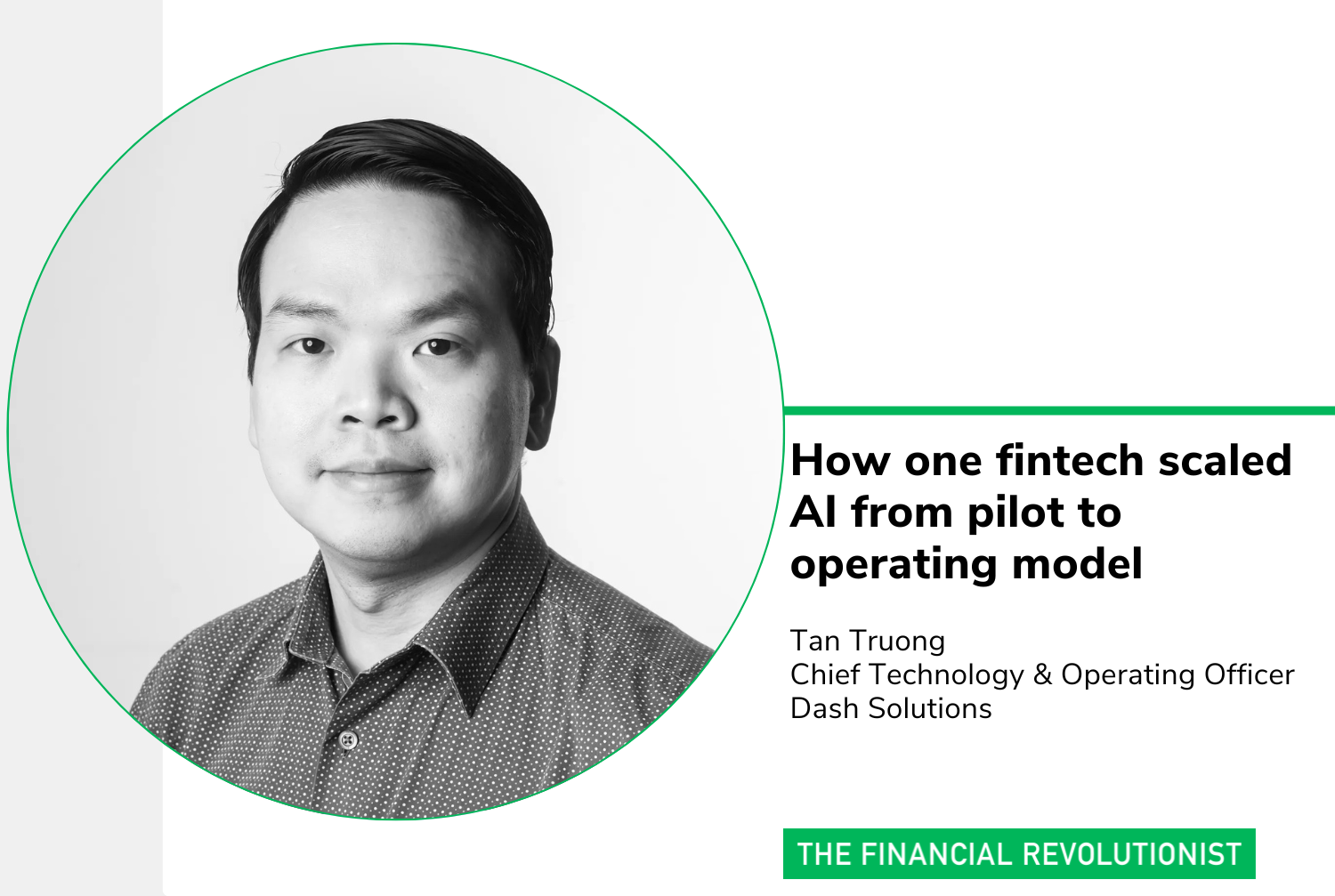
Tan Truong is chief technology and operating officer at Dash Solutions, a fintech company that helps organizations modernize how they pay, reward, and reimburse individuals through payment solutions and industry expertise.
We’ve spent the last two years embedding AI into how our company operates. The biggest lesson? The hardest part wasn’t the technology itself, but figuring out how to govern it.
Too often, companies treat AI like previous technology shifts. They buy licenses, give them to engineering and check the box, but that approach rarely changes how an organization operates at its core.
We knew we wanted something different for our company. Our goal was to make AI part of how we work every day, and to us that meant building the right culture and governance before we focused on building the technology.
As a business operating a multi-billion-dollar payments network, we knew we had to prioritize security, privacy and customer trust, but we also knew that if people weren’t clear on where AI belongs, we’d eventually create more friction than progress.
We found that AI governance does not have to slow innovation. Establishing clear rules around data access, ownership and human oversight early on helped us move faster and get more from AI without sacrificing trust.
Building culture, responsibility
Before we deployed a single agent or automated workflow, we spent our time helping employees understand how to use AI responsibly. One thing I’ve learned is that if you don’t give people an approved, secure way to use these tools, they’ll find their own!
With that in mind, we invested heavily in education. Every week we held office hours, launched monthly training sessions, created a company-wide prompt library and set-up internal channels where people could share what worked and what didn’t with AI. We also began to wrap up internal meetings asking where AI could reduce effort, improve quality or speed up processes. That helped us shift the conversation, making AI feel like something every department could use to improve their work versus just an engineering project.
If I could do one thing differently, I would have created AI champions across the business much earlier. Today we have leaders across finance, product, HR and customer experience who help identify opportunities because they’re the closest to day-to-day work. They’ve become some of our strongest advocates.
I’ll also admit that I underestimated how much work would go into getting the right enterprise agreements in place. While that caution slowed us down initially, it gave us the guardrails we needed to move fast later as we scaled AI across the company.
Governance as an accelerator
Once employees understood the tools and we had the right foundation in place, we moved into what I call our “acceleration phase.”
Internally, we started asking different questions about AI: Who owns this? What decisions should it be allowed to make, and where do people still need to be involved? This is when governance started becoming our advantage.
A fraud detection vendor informed us that it was raising our rates by 50%. Instead of renewing, we decided to rebuild the capability in-house. The original estimate called for a five-person team working for four months. By using AI agents, one project manager and one engineer built and shipped it in four weeks, largely because the governance decisions about data access and oversight had been settled before the project started rather than in the middle of it.
We saw something similar with Motivate, our enterprise employee recognition and channel partner incentives platform. By introducing an AI agent to automate rebate claims while keeping humans in the final approval process, we increased ticket processing fivefold for a single client, from 1,000 to 5,000 tickets, without adding headcount.
That’s the part of AI I find most exciting: The opportunity with this technology isn’t to replace people, but to enable our teams to accomplish far more than they could before.
The next challenge is managing agents
People keep calling 2026 the year of AI agents. I'd put it more sharply: 2026 is the year we stop supervising agents and start managing them. Most agents still need close supervision today, but that will change quickly. Over the next two years, capability will compound faster than most companies can update their operating models. The gap that matters won't be between companies that have agents and companies that don't. It will be between companies that can delegate to agents with confidence and companies that can't .
In payments, that shift is already happening. We are entering what I can only describe as the “Wild West” of agentic commerce. The same technology helping companies automate work is also giving fraudsters more sophisticated tools, creating faster attacks that are harder to detect.
That means our next challenge is deciding where AI should be allowed to act on its own, and where humans are still required in the process. Companies that invest early in clear ownership and governance will be in a much stronger position as AI becomes more autonomous. Those that skipped governance for speed may discover that fixing problems after AI is already embedded across the business is a much harder job than getting the foundation right in the first place.