How responsible AI gets built
/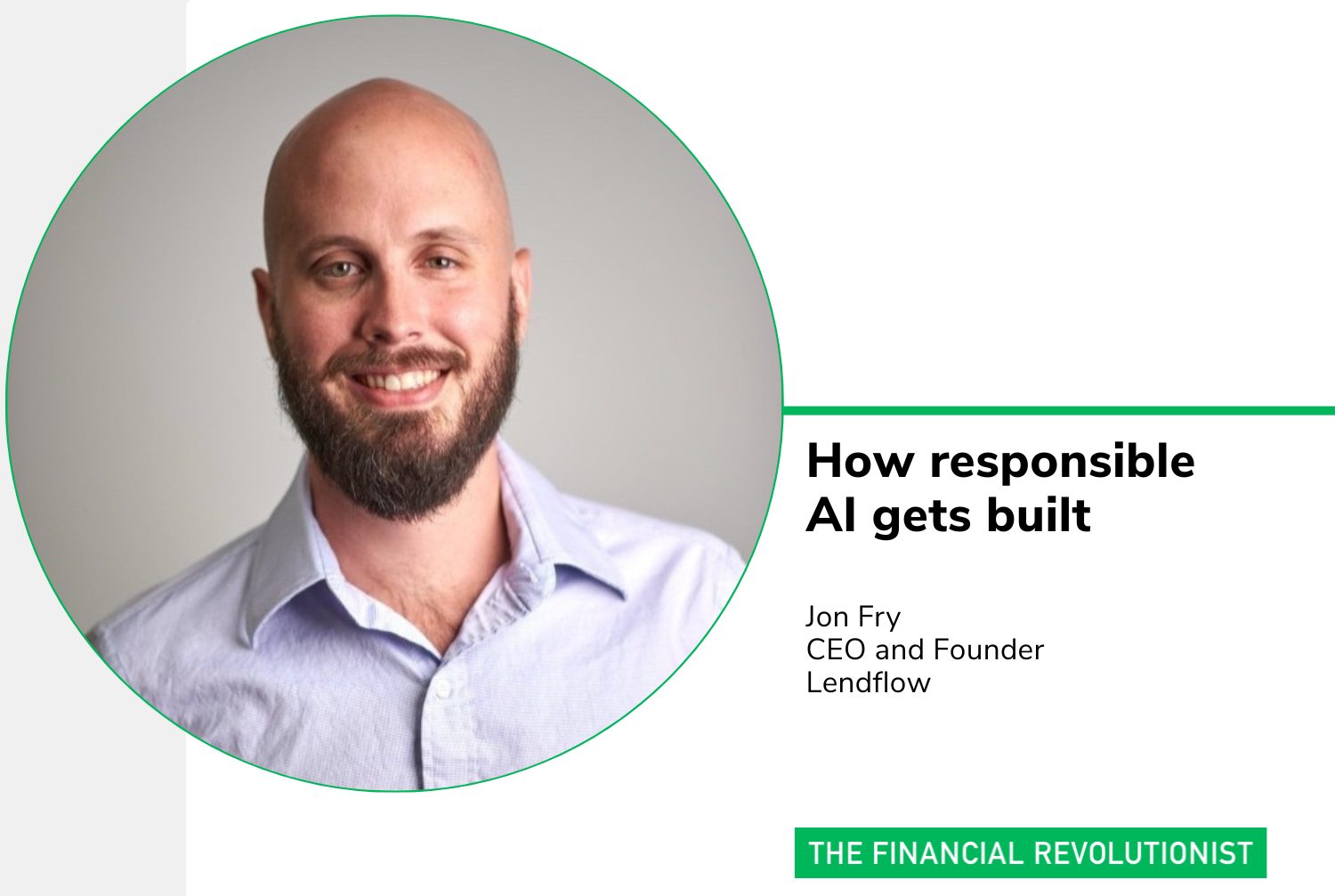
Jon Fry is CEO and founder of Lendflow, a platform that powers embedded lending infrastructure for fintechs, SaaS platforms and lenders.
AI is moving quickly from experimentation into production systems across lending and credit decisioning. As adoption accelerates, companies need to manage important risks. Decisions made by models now affect who gets credit, at what price, and under what terms. In this environment, responsible AI is not about slowing innovation, but about ensuring that automation strengthens trust, fairness, and compliance rather than weakening them.
As AI reaches mainstream adoption – particularly in financial services – lending and credit decisioning, responsibility and compliance are essential. Given its rapid development and model improvement in tandem with Big Tech investment, responsible AI has unsurprisingly generated buzz. For companies deploying AI, the challenge is defining and implementing practical frameworks that balance innovation with accountability.
Why now? Lending-specific impact potential cannot be ignored. AI can dramatically reduce capital costs for end customers, enable lenders to scale without bloat and improve customer experience. Because lending touches every part of the economy, responsibly integrating AI to deliver better, more efficient processes will profoundly impact people, businesses and the economy as a whole.
Below are five practical building blocks for lenders moving from AI experimentation to responsible deployment, without sacrificing compliance or customer trust.
1. Establish clear guardrails
Responsible AI includes core responsibility elements such as data security; vendor review processes; compliance with lending regulations; and proper engineering standards for prompt changes. Despite its simple setup, AI carries immense potential and equally powerful risks. Unchecked, it can lead to significant personally identifiable information, data security, and compliance failures. Unknowingly embedding data in partner software and bias in algorithms can reinforce inequities and errors, for example, while opaque decision-making systems can erode customer and regulator trust. While AI communicates like humans, AI runs on mathematical formulas, code and programs and should be treated differently than other software. With clear standards, organizations can treat this responsibility as a salient strategic approach, particularly in lending, where fairness and transparency prove crucial. For these reasons, the same testing and quality assurance standards must apply.
2. Keep humans in the loop
It’s no secret that AI processes large amounts of data and can surface insights faster than humans. However, machines lack the context, empathy and ability to weigh nuanced trade-offs, particularly in financial decisions that impact people’s livelihoods. In credit underwriting, for example, until AI gains more sophistication, human expertise and oversight remain integral when interpreting edge cases, contacting clients, mitigating bias and ensuring fair outcomes.
Responsible AI means training and strengthening human judgment to optimize AI as an amplifier when balancing between deploying resources, increasing / decreasing costs and improving the experience or product.
3. Weigh the risks of inaction
When AI is deployed without oversight, the consequences are tangible. Biased credit models can exclude entire communities from financial opportunities or misrepresent borrowers’ ability to repay. Opaque algorithms in hiring, healthcare or finance can expose companies to reputational, financial and regulatory risk. Trust, once broken, is difficult to rebuild, making responsibility a moral and business imperative. Because embedded lending involves more data sources and higher inappropriate data sharing risks, evolving special considerations are required to secure compliant AI systems.
4. Develop structured governance frameworks
Organizations serious about responsible AI use can select more structured approaches that include forming cross-functional teams that bring together technologists, compliance experts, risk management specialists and business leaders. Cutting-edge innovation requires embedding transparency into model development, conducting regular bias audits and ensuring accountability at every stage of the decision-making lifecycle. Workforce education is equally important, helping employees understand both AI’s capabilities and its limitations in sensitive contexts such as credit evaluation.
5. Ensure a collaborative approach
AI can best be seen as a force multiplier that augments and streamlines human teams’ low-value, high-volume work. AI agents can step in like new employees who require training and oversight. Conducting feedback loops to engineering teams ensures AI agents’ continuous improvement and a better balance of experience and lower customer capital costs. With critical human input and oversight in place, AI agents will eventually make fewer errors. Consider AI use in application drop-off /follow-up, for example.
AI agents could handle initial outreach by facilitating application completion, followed by humans who would provide white-glove experiences to a wider range of the credit spectrum. When assessing credit risk, AI agents could transcribe documents, trigger data enrichment, run calculations and prepare loan packages for human evaluation. Human teams could then quickly conduct higher-value activities such as validating data accuracy, auditing for bias, investigating AI recommendations, and confirming details with the customer as needed.
Thinking ahead
Over the next five years, expect consolidation from point solutions into flexible platforms, moves away from legacy data stacks to support AI optimization, a shift toward locally hosted and open-source models, wider use of narrowly focused agents over general foundation models, and greater internal development of IP rather than reliance on third-party models.
Some emerging challenges to monitor as organizations seek AI productivity gains include data security lapses from teams unfamiliar with compliance processes, as well as the use of multiple point solutions without a clear understanding of data flows.
Additional risks include memory-related challenges, where AI models acquisition of new knowledge causes them to forget previously learned information, and hallucinations, in which models generate incorrect or fabricated outputs that can mislead users or decision-making.
AI can quickly turn into a threat when not utilized responsibly. Clarity, organization and dedication to finding a balance between human judgment and machine intelligence are necessary to successfully apply consistent standards. Businesses that view responsible AI as a strategic and moral necessity will not only shield themselves from danger but also set the paradigm for a more inventive and just future.