Fintech’s next phase will be orchestrated, not adopted
/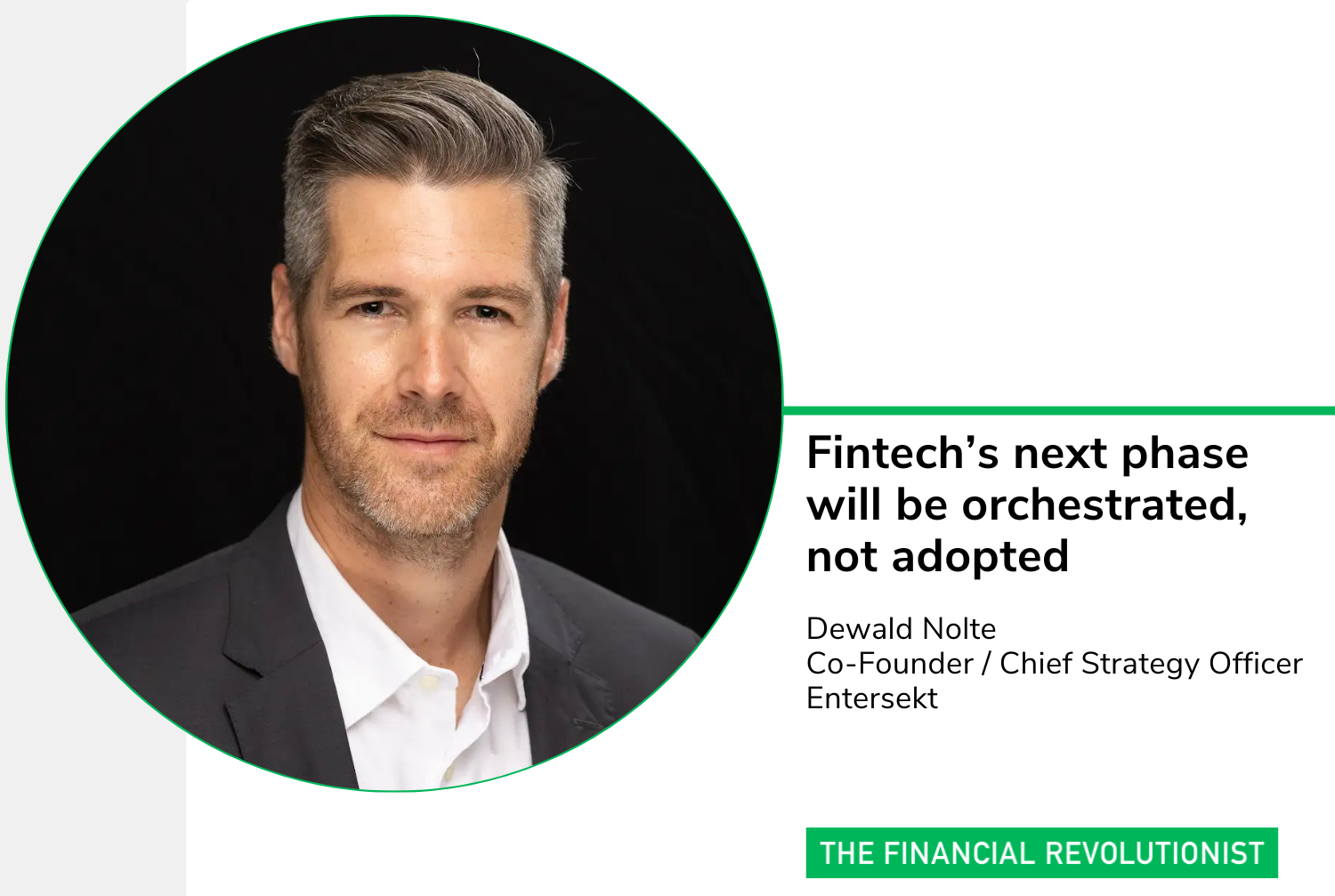
Dewald Nolte is the co-founder and chief strategy officer at Entersekt, a fintech company specializing in secure authentication solutions.
Digital wallets, tokenized deposits and AI agents are converging to transform financial infrastructure, pushing fintech into a new phase where programmable money and orchestration, not standalone innovation, define competitive advantage.
Industries often talk about “inflection points” — pivotal moments when some form of meaningful change redirects future results, for better or worse. However, the term barely does justice to the size and implications of the transformation underway in the financial technology industry. And it doesn’t begin to capture the urgency of getting the industry’s next phase of growth right.
Digital assets, previously regarded as niche experiments, are now the foundational architecture of modern finance. While global policy updates, including the landmark U.S. GENIUS Act and Europe’s full implementation of the MiCA framework, propelled this evolution, it represents far more than new regulations.
The shift stems from traditional banking’s introduction to decentralized technology, and it has ushered in a faster, more inclusive, always-on global economy. The tokenization of real-world assets, the rise of programmable money — such as stablecoins and tokenized deposits — and the emergence of agentic finance are further proof of that.
Digital wallets offer a new operating system for money
With 5.2 billion consumers now using digital wallets, they have become the primary interface for global commerce. Use of plastic cards is dwindling thanks to the convenience of having stored card information at the consumers’ fingertips for fast, low-touch transactions. Fintech giants are launching interoperable aliases so users can send and receive payments between different apps, starting with services like Visa+, PayPal, Venmo and DailyPay.
Now users can adjust device settings to integrate digital wallets into their daily lives so seamlessly that they no longer have to pause and open an app. When absorbed in fast-paced digital activities, like gaming or the emerging trend of agentic shopping, consumers can grant their wallets a “session key,” allowing apps to make small, pre-approved payments for a limited time without requiring a face scan or fingerprint for every micro purchase. The model balances security with friction-free access.
The rise of programmable money
Digital currencies, which have effectively replaced traditional wire transfers for high-value transactions, dominate the current payment landscape. Cryptocurrencies first garnered attention in the early 2020s, driven by a pandemic-era boom where Bitcoin surged by 300%. The real workhorse of this era, however, is the tokenized deposit.
The digital version of the money that is already in a user’s account, tokenized deposits, are protected by deposit insurance and offer the speed of blockchain with the safety of traditional banking. This technology has proven especially useful for institutional settlements and corporate treasury operations. Businesses can instantly move their available cash or cash equivalents from one place to another without multi-day legacy banking delays. This capability, when combined with agentic payments, enables automated, programmable value transfers that were previously impossible.
Agentic finance gives AI a wallet
Agentic finance is undoubtedly the breakout trend of 2026. Simple chatbots are a relic of the past, having been replaced by specialized AI agents equipped with unique decentralized identities and programmable wallets. In this new ecosystem, AI agents have the autonomy to execute tasks, though oversight is still a part of the process. When an agent initiates a payment, the banking layer confirms that the agent is “bound” to a verified human or corporation. Verified identity connections are crucial to prevent anonymous “rogue agents” from clogging the financial system or executing unauthorized transactions.
Security in this agentic world operates on a zero-trust model. To protect sensitive data, AI “sees” the product and the price, but it never accesses raw credit card numbers. Instead, it uses dynamic tokens, payment credentials that are only valid for a specific merchant and amount. So if an agent is compromised, the underlying financial assets remain secure.
The distinction between “fintech” and “finance” is thinning as infrastructure becomes smarter, faster and more autonomous. Financial leaders’ new challenge is understanding how to orchestrate new technology rather than simply adopting it. Organizations must approach this safely, whether making digital wallets interoperable, integrating tokenized assets into legacy systems or building the trust layers AI agents require to operate.
Fortunately, the tools exist and the regulatory frameworks are in place. Any organization that recognizes the importance of evolving is now free to do so confidently and securely.