AI agents are testing the limits of payment accountability
/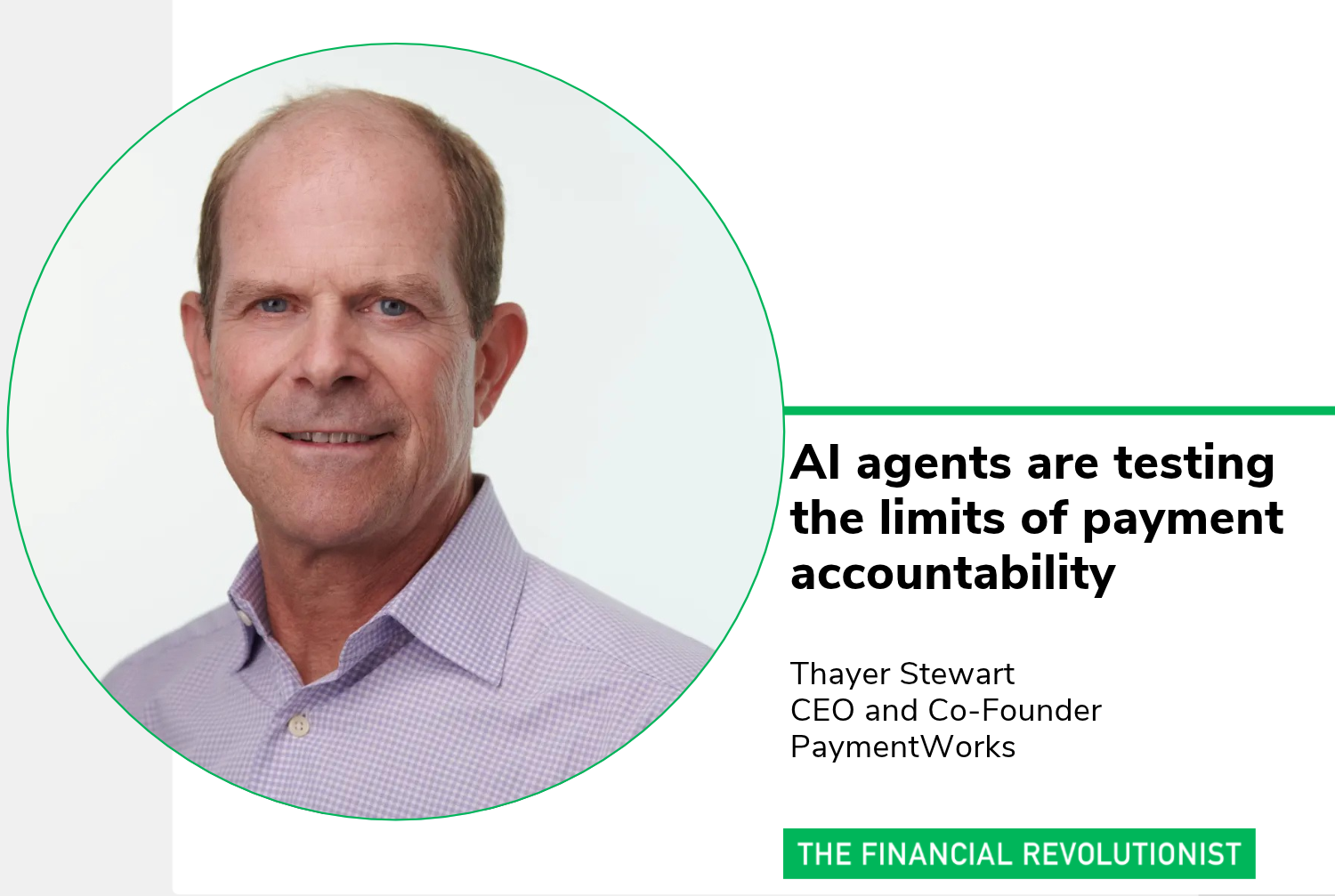
Thayer Stewart is CEO and co-founder of PaymentWorks, which provides vendor identity infrastructure for businesses.
At the Sibos conference in Miami in September, Federal Reserve Governor Christopher Waller asked the payments industry a defining question of the AI era: Who pays when an AI agent gets it wrong?
In his speech, “Payments in the Age of AI Agents,” Waller suggested adapting existing e-commerce liability frameworks or testing new approaches. He also pointed to the need for technical standards that clarify what a buyer intended and how an agent carried out that intent.
That is the right debate, but it starts one step too late. Liability cannot be determined fairly if the parties cannot establish what the agent was authorized to do.
The stakes are significant. The ACH Network processed $93 trillion in 2025, including $63 trillion in business-to-business payments. A growing share of that activity could soon be initiated not by a CFO clicking “approve” but by software agents selecting vendors, placing orders and directing funds.
That future exposes a longstanding flaw: The procure-to-pay value chain evolved backward. Businesses digitized procurement and automated accounts payable before optimizing payment rails, spurring payment orchestration, wider use of virtual cards and instant payment options.
Only now, in B2B, are we confronting weaknesses in the identity layer on which these systems rely. We treated the starting point as the last mile.
From authentication to provenance
When software can act autonomously on a company's behalf, the most consequential part of a payment may happen before it is initiated.
A Bank for International Settlements working paper found that a generative AI agent could perform complex liquidity-management tasks in simulated wholesale payment scenarios, highlighting the need for safeguards as AI takes on more consequential financial decisions.
The National Institute of Standards and Technology is examining how software and AI agents should be identified and how records of their actions can be audited and used to establish who did what.
These developments point to a prerequisite for resolving Waller's question: establishing not only what a buyer intended, but whether an agent had the authority to act on that intent.
Neither liability frameworks nor technical standards will suffice if the evidence needed to determine whether an agent acted within its authority is missing, fragmented or confined to one company's platform.
Identity alone isn't authority
A supplier receiving an order from an AI agent needs to know: Is this a legitimate actor or a scam bot? Which business does it represent? Has that business authorized it to act, and within what limits?
Today, trust in B2B commerce rests on vendor records, employee credentials, contracts and past relationships. That is shaky even for human-driven commerce. For autonomous agents, it is nowhere near enough.
NIST's work points toward a basic principle: Agents need identities, credentials and defined entitlements rather than simply inheriting a human user's access.
Build a network, not another database
Payment networks are developing tools for verified agents, addressing an important part of the problem. But those efforts may fall short when transactions span multiple businesses and platforms.
The lesson from companies’ master lists of approved vendors is simple: Static, isolated records don't work in a dynamic, networked world.
If software agents are to transact at scale, information about their identities and permissions must be portable. Companies should not have to start from scratch each time they verify whether an agent is legitimate, which company it represents and what it is authorized to do.
A workable agentic commerce ecosystem needs verifiable credentials that travel across business relationships. That doesn't require one giant central database. It does require shared standards and interoperability.
If every bank, company, agent platform and payment provider develops its own way to verify permissions, the industry will recreate today's friction, with software transacting faster than humans can keep up.
That makes governance as important as technology. Banks, businesses and payment providers will need common expectations for delegation and risk management. Industry-governed networks, rather than standalone platforms, can help trust scale.
Turn transactions into evidence
Financial institutions have long competed on the payment itself: faster rails, better card products, cheaper ACH and slicker platforms. On their own, these are different ways to move money.
In an agentic environment, the transaction record becomes something more important: evidence.
A richer record could help banks and businesses understand gaps in payment adoption and improve working capital management. It could also help establish what happened when an agent picks the wrong supplier, exceeds a budget or falls for a fraud scheme.
Our current dispute and chargeback frameworks weren't built for that.
Banks must help establish the standard
Banks can move upstream, to the moment vendors and agents first enter the system, and help establish controls and records that set clear boundaries around autonomous activity.
Financial institutions already work with business identity, account ownership, authorization and transaction history. The challenge is connecting those mechanisms when a software-initiated transaction involves multiple parties.
When a person says, “I didn't authorize this payment,” there is a relatively familiar question to investigate. In an agentic transaction, the question is more complicated: Was the agent operating within the authority it was given?
Answering requires more than a payment record. It requires evidence of the decisions that led to the transaction.
Set the rules before the first dispute
The Fed has put liability for AI-agent payments on the table. The industry should not wait for disputed transactions to decide what evidence is needed to assign it.
That means clearer controls for software operating on a customer's behalf, expectations for audit trails and processes for investigating transactions initiated by autonomous systems. It also means rethinking fraud and dispute frameworks so responsibility follows the chain of authorization rather than just the final payment event.
The strategic question for banks is not whether to build another layer of payments infrastructure. It is whether their role as trusted intermediaries can evolve for a world in which businesses increasingly connect with vendors, agents and merchants through a networked ecosystem.
We've spent years automating around a starting point never designed for machine-to-machine commerce. Agentic commerce gives banks a chance to rethink where responsibility begins.
The future of B2B payments will depend less on how quickly money moves than on whether businesses can trust where it is going. The technology will move quickly. The rules governing accountability must keep pace.