Why the rewards economy needs better rails
/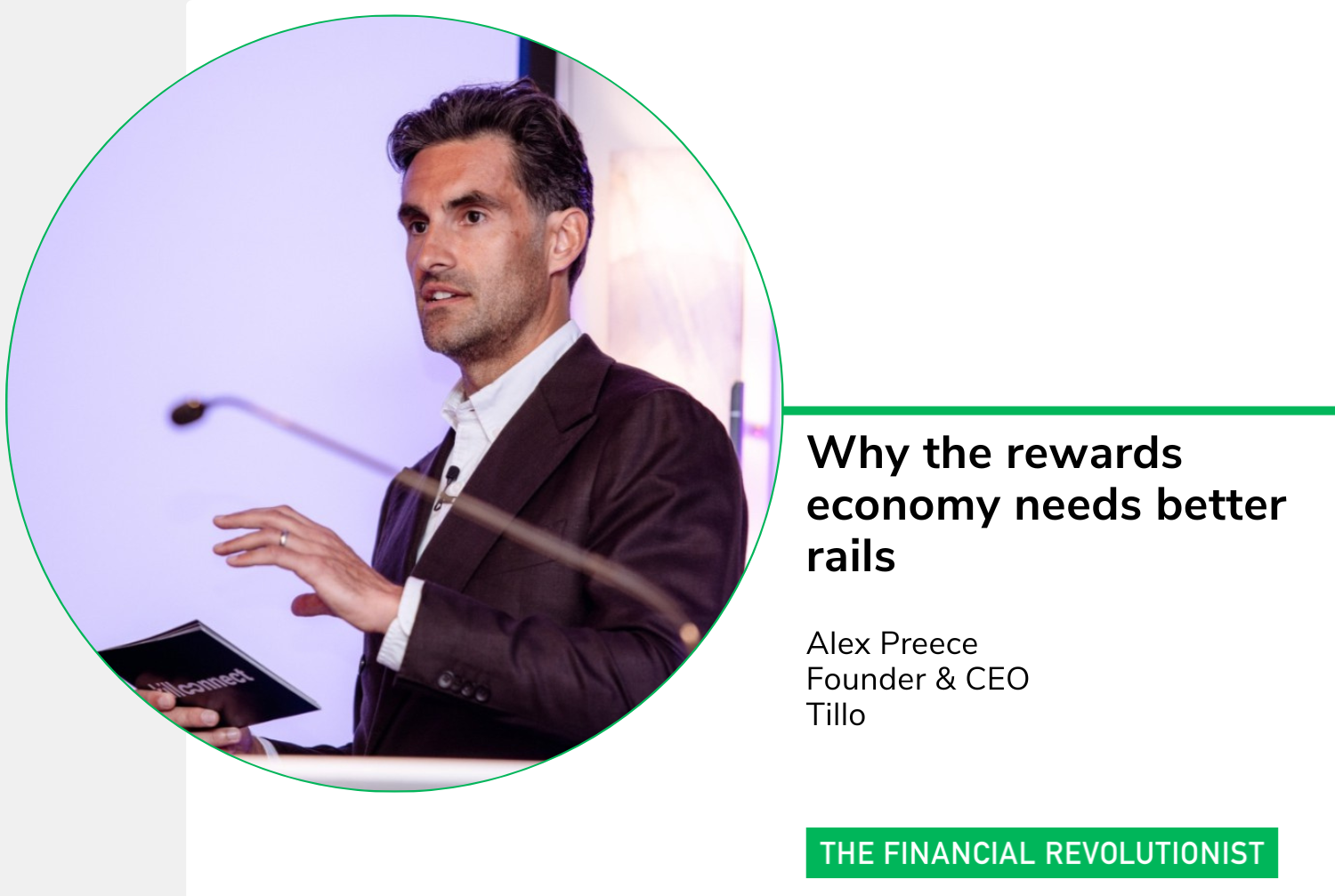
For today's edition of The FR, our editors sat down with Alex Preece, founder and CEO of Tillo, a digital gifting and rewards platform that connects brands with businesses looking to deploy gift cards, incentives, and stored-value products at scale. In this conversation, he discusses the fragmentation behind the digital rewards economy and why the infrastructure powering loyalty programs is lagging behind.
A British Army veteran who served on active duty in Bosnia and Iraq, Preece learned firsthand how small failures in systems and incentives can have real-world consequences. As Tillo marks its tenth year, he has spent the past decade applying that discipline to building the invisible infrastructure that powers digital rewards across banks, fintechs and global brands.
What are the core challenges in the digital gift card market today?
The core problem is that demand has outpaced infrastructure. Digital gift cards now span retail, payments, fintech loyalty and cross-border commerce, but the systems behind them remain fragmented. Brands juggle multiple distributors, settlement models, currencies, fraud controls and regulations, while consumers face inconsistent redemption rules and limited interoperability between platforms.
There is also a classification gap. Gift cards sit directly between marketing and payments, and many organizations still treat them as promotions rather than stored value – effectively prepaid financial instruments. That mindset leads to underinvestment in the operational capabilities needed to scale them securely across multiple use cases.
Additionally, fraud has long challenged both physical and digital gift cards. Physical formats face tampering and point-of-sale manipulation, while digital formats introduce velocity and cross-border complexity. The real issue isn’t the format – it’s whether infrastructure and controls evolve fast enough to support scale.
Gift cards are no longer a niche perk – they are digital currency. The infrastructure simply hasn’t caught up yet.
The digital gift card market has evolved rapidly, but brands and consumers are still losing out in ways that feel avoidable. What needs to change, and why hasn't it happened yet?
What’s missing is connective infrastructure. Gift cards often move through a patchwork of legacy systems, manual processes and regional arrangements, creating inefficiencies across issuance, distribution, redemption, reconciliation and reporting. That translates into higher costs for brands and friction for consumers.
Consumers lose out when value is hard to discover, difficult to redeem or restricted by geography or channel. Brands and fintechs lose when overheads and fragmented data obscure real customer insight.
The shift required is from treating gift cards as campaign tools to programmable stored value – assets that can move instantly across digital ecosystems. That means standardized rails, API-driven distribution, real-time fulfillment and the ability to serve customers wherever they are – physically or digitally.
This transformation requires coordination across historically siloed industries: retailers, payment networks, regulators, fintech platforms and loyalty providers. The work is complex, commercially sensitive and largely invisible.
When I first entered the space a decade ago, digital commerce was accelerating while connective rails lagged behind. Now, ten years later, the market is far more mature, but the next phase is less about invention and more about integration at global scale.
Rewards and loyalty programs in fintech and financial services are everywhere. but which ones are actually moving the needle on customer relationships, and which are falling flat?
Programs that drive real loyalty deliver tangible utility, not symbolic perks. Points, cashback and sign-up bonuses can spark short-term behavior, but they rarely sustain relationships because consumers quickly normalize them.
What works is value tied to real financial outcomes – lowering everyday costs, funding savings goals or enabling planned purchases. When rewards feel like progress, they become part of daily life rather than a marketing incentive.
Programs fall flat when they add friction. If customers must track rules, convert points or navigate multiple platforms to redeem benefits, the effort outweighs the benefit and loyalty becomes purely transactional.
Financial services face an additional structural hurdle: banking interactions are functional, not emotional. The programs that succeed extend beyond the product itself and connect to the brands and experiences people already care about. A decade of innovation and learning has shown us that loyalty isn’t built inside the product – it’s built where the product meets real life.
How can fintechs make loyalty a natural, visible part of the everyday customer experience?
Loyalty feels natural when it is embedded into behavior, not layered on top. Customers shouldn’t have to hunt for rewards or change how they use a product to unlock value. The benefit should appear automatically as they spend, save or manage money. The most effective programs surface benefits at the moment they matter – at the moment of purchase, during bill payment or when a financial decision is being made.
Relevance and timing matter are as important as the reward itself. Used responsibly, behavioral data can deliver context-aware incentives tied to location, spending patterns or goals. A generic offer feels like advertising, but a timely one feels like assistance.
There is also a shift from deferred rewards to immediate utility. Consumers increasingly prefer benefits that reduce costs today – bill offsets, instant discounts or contributions to savings and debt reduction.
Finally, loyalty must operate across an ecosystem. Fintech apps are rarely the center of a customer’s emotional world, but the merchants they interact with daily are. Integrating those brands turn transactional services into relational experiences.
The most effective model creates a three-way value exchange – a power triangle. Brand gains access to new, high-intent customers. The fintech platform turns loyalty from a cost center into a revenue driver. And the customer – the most important participant – sees their paycheck stretch further while being rewarded for everyday spending.
As Tillo marks ten years in business, one insight stands out. Loyalty isn’t a feature added late – it’s a design decision about how value flows through a customer’s life. When done well, it becomes almost invisible, and that invisibility is precisely what makes it powerful.