Four AI moves for bank CEOs
/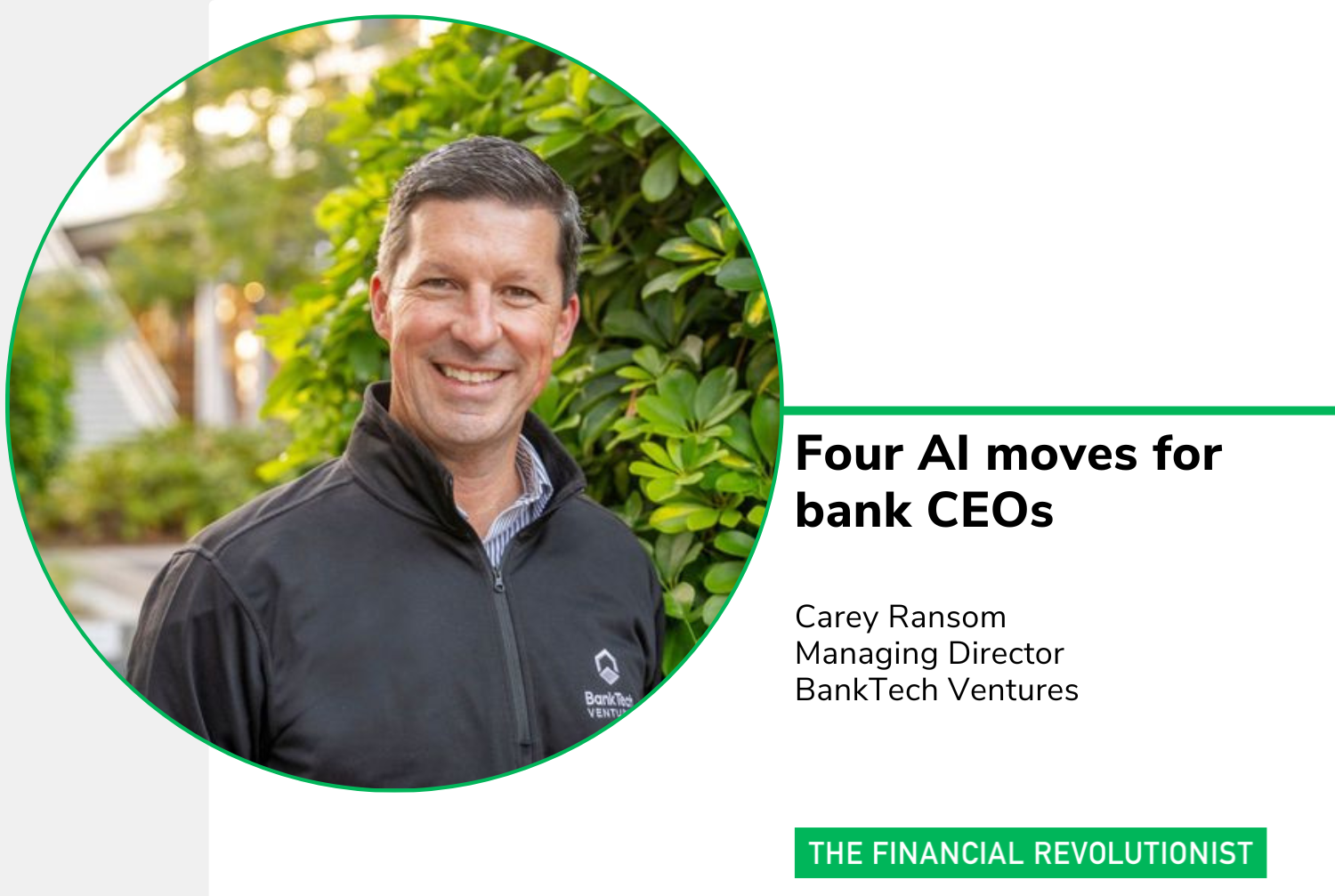
Carey Ransom is a SaaS entrepreneur, executive, investor and advisor. He is president of Operate and managing director of BankTech Ventures, a strategic investment fund focused on technologies for community banks, founded and funded by leaders in the community bank ecosystem.
I get the privilege of meeting with hundreds of community bankers every year, and "looking for AI use cases” has become the single most productive-sounding way so far to do very little about AI. It lets a leadership team feel busy without really changing anything, and it quietly concedes the future to competitors who stop waiting.
The right posture is the opposite. Assume every process in your bank is going to be touched or rebuilt by AI in the next three to five years. Then act like you believe it. That’s a leadership stance and it changes what you do on Monday morning.
If I had the CEO seat tomorrow, here are the four moves I’d make.
1. Take an honest inventory of your team’s AI ability, and pay people to automate themselves out of work they hate.
Every bank already has an AI maturity ladder running through it. We just haven’t measured it. Some people on the team have never used a real AI tool. Some are running their own workflow through ChatGPT or Claude every day and not telling anyone because they’re worried about getting in trouble. Most are somewhere in between.
I’d start by figuring out where each person actually sits. A simple, honest assessment. Five rungs is plenty to start:
R1. Have they used any AI tool for real work — drafting a memo, summarizing a document, or asking a question they would have Googled before AI existed?
R2. Can they describe what an agent is, what a prompt does, and where a model's limits are? Do they know, for instance, why ChatGPT might confidently give them a wrong answer?
R3. Have they automated any part of their own job? A recurring report, a customer email response pattern, or a specific compliance workflow?
R4. Have they built a small workflow that hands work off between tools, pulling data from one system, summarizing it, and routing it into another?
R5. Are they actively rethinking and redesigning processes around what AI now makes possible, rather than simply speeding up the old way?
Then I’d flip the incentive structure. Today, most banks reward the volume of work performed by the person. I’d reward the volume of work performed by the person’s AI.
Whoever can offload the most of their job to thoughtful, well-checked automation gets recognized, paid, and given more time to think. Definitely not laid off. Instead, they're promoted into the harder, more interesting work the bank actually needs done, such as redesigning a product, advising a frustrated business customer, or rebuilding a process from scratch.
The people who climb the AI ladder fastest are the bank’s most likely future leaders. They’re showing, in real time, that they can absorb new tools, redesign their own work, and treat the bank as a system to improve rather than a set of tasks to repeat. Those are the traits bank CEOs will want at the top of the organization three years from now. Find them now, before someone else does.
2. Hire at least one young AI-native person, and protect them while they learn banking.
Banks are full of people who know banking and are learning AI. They’re going to need help from the other direction. Hire at least one young person, whether a recent grad, a junior career changer, or an exceptional intern, who has been using AI as a digital coworker since high school. They don’t need to know banking yet. They need to be willing to observe it and learn it, and they need to be deeply fluent in the tools.
Then make room for them. That’s the part most banks will initially get wrong. They’ll bring in a young digital native, plug them into an existing team, and watch them get crushed by “that’s not how we do it here.” A few months later the person will leave, and the bank will wrongly conclude that hiring young talent doesn’t work.
What actually works is the opposite. Give them air cover from the top. Have them sit in on real meetings, including with regulators and customers. Pair them with one of the most senior, most curious bankers in a true exchange: the banker explains why the bank does what it does, and the young hire shows what AI can potentially improve about it. The output isn’t a report. It’s a series of small, working prototypes that get refined and put into production.
One person can’t transform a bank. But one person placed correctly, with the CEO’s visible backing, can shift the conversation in every department they touch. That’s the goal.
3. Run two AI tracks in parallel: experiment broadly, build narrowly.
There are two kinds of AI work a bank needs to do right now, and they require different mindsets.
The first is experimentation. Let people try things. Pay for ChatGPT Enterprise, Claude for Work, Microsoft Copilot, Gemini, or whatever your security team can reasonably clear. If you’re struggling there then get a fully controlled Abacus Go1 AI appliance. Do pilots or proofs-of-concept of the agentic tools showing up in every category your bank cares about: lending, deposit operations, customer service, fraud, compliance, marketing. Encourage your team to try them, share what works, and walk away from what doesn’t. The point isn’t to standardize but to build organizational fluency. You can’t make a strategic bet on AI when nobody in the building has actually used the tools.
The second track is building. While the experimentation track runs, you also have to start putting in the foundations of what will be uniquely yours. That means cleaning up your data and organizing it. It means picking a small number of workflows that are central to your bank’s identity and rebuilding them with AI at the core, not bolted on. It means owning the agents, prompts, and integrations that touch your customer in distinctive ways, rather than renting them from a vendor every other bank in your peer group is also renting from.
Most banks are picking one track now and will probably get stuck. The experimenters end up with a hundred logins and no compounding advantage. The builders end up with an eighteen-month roadmap that ships too late. I think you need both. And you need them in conversation every week. What the experimenters learn this month is what the builders prioritize next month.
4. Find new benchmarks. Stop comparing yourself only to other banks.
The peer group every bank uses today is other banks. I think it is also the wrong peer group for the next five years.
Other banks are mostly facing the same constraints you are: the same regulators, the same core providers, the same vendor pitches. Which means most of what they’re doing looks a lot like what you’re doing. Benchmarking against them tells you whether you’re average. It doesn’t tell you what’s possible.
Pick a different set for various benchmarks. Start with your most demanding, forward-thinking business customers, the ones already running AI inside their own companies. Ask them how their expectations of a banking partner are changing, and what they wish you could do that you can’t. Be vulnerable and proactive with them. I bet they’ll tell you, and the answers will be uncomfortably specific.
Then pick a handful of companies you admire that aren’t in banking at all. Like Stripe for developer-grade onboarding, Costco for a ruthless focus on their customers’ economic interests, or Vanguard for the discipline of doing fewer things better. Watch what they do and how they do it. Not because you’re going to copy them, but because they’ll reset what “good” looks like inside your own head and how values can be expressed in excellent ways.
The banks that win the next decade will look less like their peer group and more
like a software company that happens to be regulated. The core of a bank is changing in the most radical ways you’ve ever considered.
None of these moves require a new strategic plan, a vendor selection process, or a board presentation. They require a CEO to decide that this is the work, and to start doing it visibly. Tomorrow.
One percent better, every day. Which means nearly 38x better in a year. Across enough days, that compounds into the bank your community actually needs.