What AI transformation demands from leaders
/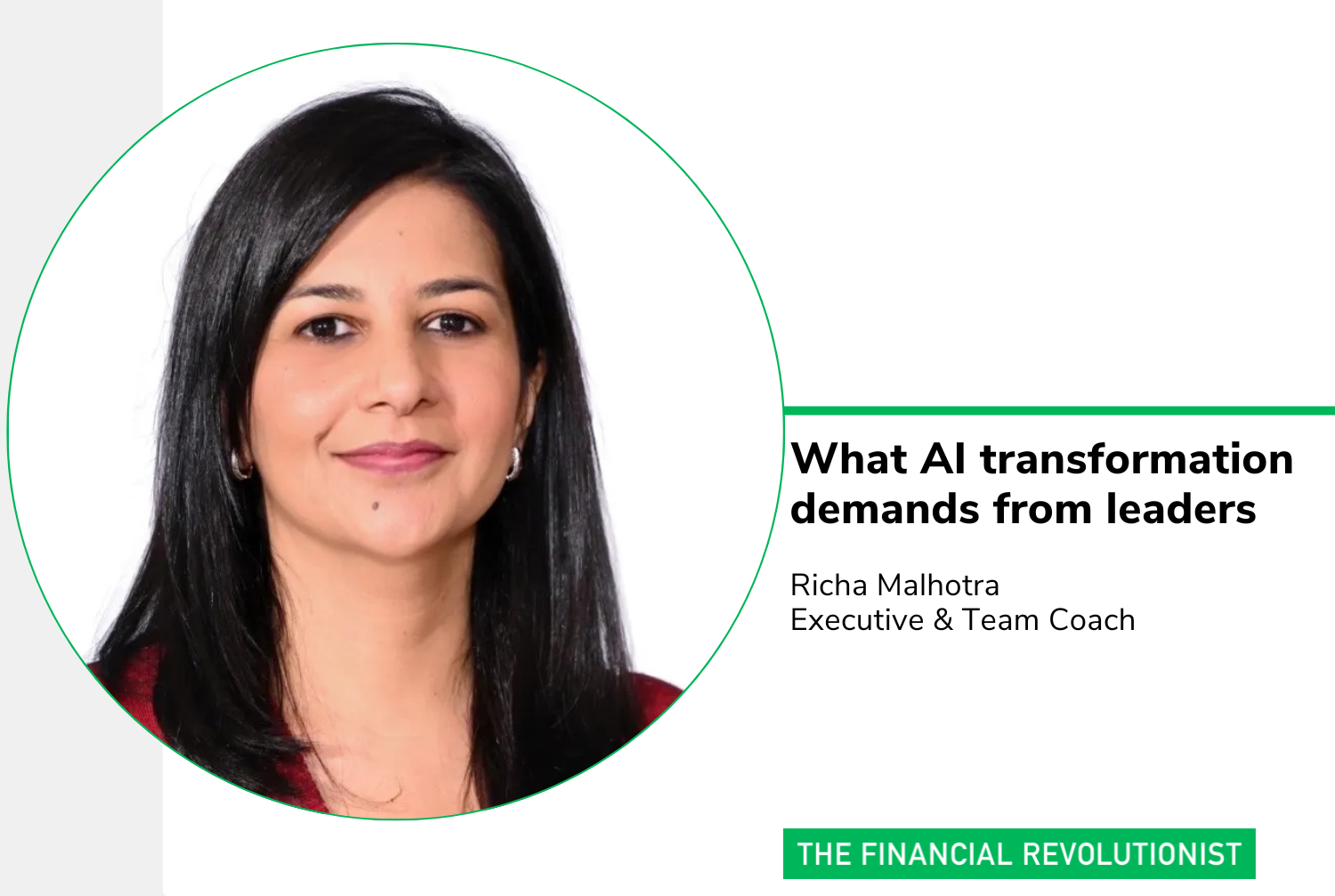
In this Q&A, Richa Malhotra, executive and team coach with a focus on tech and finance, discusses why transformation is as much a leadership challenge as a technology challenge and what helps teams stay aligned under pressure.
As AI changes how financial institutions operate, what leadership challenges are proving harder than the technology itself?
The leaders I coach are navigating AI with a mix of curiosity, opportunity, and uncertainty.
One recurring theme is that AI is not only a technology shift; it is also a leadership challenge. My experience in product roles at technology and financial services companies reinforced that new tools only create value when people are able to understand them, trust them, and work differently.
Many leaders see AI's potential to improve productivity and open up new possibilities. At the same time, they are navigating questions about what should be automated, where human judgment still matters, and how to move forward responsibly.
Where they struggle is having to move before they feel ready. They need to make decisions without all the answers, encourage innovation while creating guardrails, and provide clarity while things are still evolving.
I help leaders sit with that uncertainty before they try to communicate it to others. From there, they can be more transparent about what they know, honest about what they are still learning, and thoughtful about creating conditions for experimentation, trust, and sound decision-making.
When priorities are changing quickly, how can leaders distinguish the real priority from the loudest signal?
One of the biggest challenges under pressure is maintaining clarity in the middle of complexity. When priorities are shifting and demands are coming from multiple directions, it is natural for leaders to move quickly and focus on execution. The risk is that stress can limit perspective. Communication gets shorter, listening gets harder, patience decreases, and decisions can become more rigid or reactive.
That is why the ability to pause, step back, and regain perspective matters. I often ask leaders: What matters most now? What has changed? Are we responding to the real priority or simply the loudest signal?
This becomes even more important as leaders become more senior, because their stress has a ripple effect. It shapes how steady or reactive the team becomes.
The leaders who navigate sustained pressure best are often not the ones moving the fastest. They are the ones who can maintain perspective, make thoughtful decisions, and help their teams do the same.
When leadership teams struggle with execution or accountability, what is often happening beneath the surface?
A common denominator is often unspoken misalignment within the team.
On the surface, teams may describe issues around communication, execution, accountability, or decision-making. But underneath, there are often competing priorities, unclear expectations, or concerns people are not discussing openly. Over time, that can create friction, slow decisions, and reduce alignment across the team.
My role with the team is to help make those patterns more visible and create space for more honest dialogue, so the team can move forward with greater clarity and shared ownership.
What leadership blind spot most often prevents teams from taking ownership or speaking candidly?
One common blind spot is that leaders underestimate how much their own behavior shapes how others around them show up.
For example, a leader who micromanages may experience a team that does not take enough ownership. A leader who is not inclusive may experience quieter participation or less candor. A leader who is consistently rushed or hard to read may find that people bring them only polished updates rather than early concerns.
What surprises people is that these patterns can look like a team issue, when they may also reflect a leadership pattern. The team may be responding to the environment the leader is creating, often unintentionally.
When I coach leaders, I help them see that connection more clearly. Together, we identify patterns in how they lead, gather feedback from others, and look at the gap between their intention and their impact.
What becomes powerful is that when leaders shift, teams often shift with them. A leader who creates more space may start to see more ownership. A leader who listens differently may hear more honest input. A leader who invites participation more intentionally may find that people begin stepping in with more confidence.
What enables an organization to withstand prolonged disruption without becoming reactive?
In periods of disruption, people need to speak honestly and surface risks early. That happens when leaders create enough trust for information to move through the system.
In executive coaching, I help leaders stay grounded and communicate clearly when priorities are shifting and they do not have all the answers. People look to leaders not only for direction, but also for cues about how to respond.
In team coaching, an important question is whether the leadership team is operating as a true team or as a group of strong individual leaders. That shows up in how they handle disagreement and stay aligned under pressure.
A big part of my role is creating the space for leaders and teams to be honest, vulnerable, and willing to have the difficult conversations they may be avoiding. Those conversations often reveal what needs attention most.
That is what helps cultures withstand disruption: not certainty, but the ability to keep learning, adapting, and responding intentionally.
What separates evidence-based coaching from a thoughtful conversation, and why does that distinction matter?
To me, being an evidence-based coach means that while every coaching conversation is centered on the individual leader and their unique context, the work is informed by established research on leadership, psychology, communication, behavior change, adult development, and team effectiveness.
That distinction matters because coaching is not just a thoughtful conversation. Leaders are investing real time, energy, and attention while navigating complex responsibilities and high-stakes decisions. I believe the work should be grounded in approaches that support meaningful growth.
At the same time, evidence-based coaching does not mean applying the same approach to every leader or team. The research provides a foundation, while the coaching is tailored to the specific context, challenges, and goals of the people I am working with.
For me, the value is in that balance: coaching that is grounded in what we know about how people learn, change, and lead, and responsive to the leader or team in front of me.
After two decades in financial services and technology, what convinced you that leadership was the variable you wanted to focus on?
Looking back, the move into coaching was a natural evolution of the questions I had been drawn to for years.
After nearly two decades in financial services and technology, including product marketing roles at Citibank and Dell following my MBA, I made the decision to leave a career I had enjoyed and invested in deeply, without knowing exactly what would come next.
My experience in large organizations has deepened my understanding of what it really takes to move work forward: how complex systems operate and how strategy turns into execution.
What became increasingly clear to me was that leadership often made the difference between potential and performance. Whether I was launching products, building marketing strategies, or leading cross-functional initiatives, I saw that the quality of leadership influenced whether good ideas translated into meaningful results.
I found myself increasingly drawn to the human side of leadership, and coaching became the clearest expression of that passion.
Coaching offered a structured way to work with what I had been observing for years: how leaders shape performance through the way they think, relate, and lead.
What continues to excite me about this work is witnessing moments of growth that create new possibilities. Sometimes it's a leader finding the confidence to lead in a way that feels more authentic. Sometimes it's a team having a conversation they've been avoiding for months. Those moments can change not only how people work together, but how much joy and meaning they experience in the work itself.