The AI wealth boom is exposing a divide over who gets to invest
/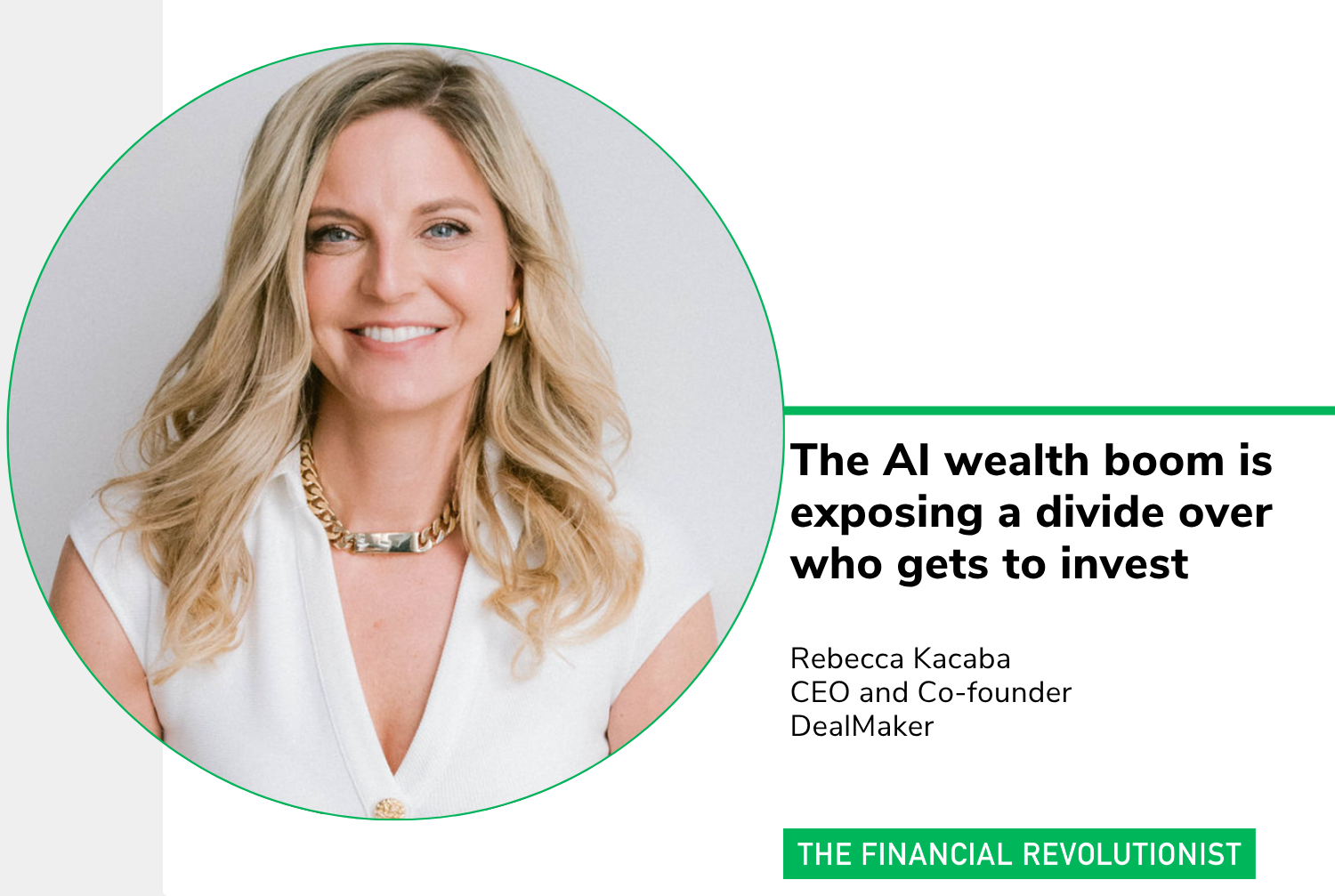
Rebecca Kacaba is CEO and co-founder of DealMaker, a company that operates a capital-raising platform used by companies conducting online securities offerings.
In July, the company I helped found and now run, DealMaker, surveyed two thousand Americans about how they felt about the wealth being created in the market, their ability to access investments, the economic opportunity they saw and anxiety they felt.
Off the bat, the economic anxiety we recognized in the data, especially around the masses of wealth being created around AI, seemed profound. Fifty-seven percent of respondents (including majorities in every political group) supported Bernie Sanders’ plan to create a sovereign wealth fund through a one-time 50% tax on the stock of the largest AI companies, with those shares deposited into the fund. Americans don’t agree on much, but apparently, we now agree on the government taking a massive cut of technology companies.
A lot of attention is being given to data center and job loss concerns. Less is being given to how people respond to just how unevenly new wealth is being created. As Anthropic eyes a $2 trillion IPO, this story doesn’t hit Americans as innovation. It makes them feel on the outside. In our survey two-thirds of people said they felt all Americans should be able to benefit from AI’s growth, given its impact, and 63% felt that AI would make inequality worse.
Americans want to benefit, but there’s a very simple dynamic keeping them locked out of the highest-growth investments. No one really talks about it, or acknowledges it. But if you know, you know. And without any direct action, Americans are starting to coalesce around extreme policy positions.
Accredited investor rules were designed in 1982, setting income, net wealth and certification requirements for people making private investments. They’re the reason you can buy stock in an exchange, but are kept out of most major private fundraising rounds. These rules are supposed to protect people from higher risk investments they can’t properly assess, and make sure the people making these investments can bear any loss.
Four decades later their major legacy has been amplifying income inequality. When you look at the intent of these rules, versus the wider context of the economy, they’ve become nonsensical.
The internet didn’t exist in 1982, and the average American now can learn a lot about investing. There’s six times as many money brokerage accounts in the US than there were four decades ago. The growth of new investment platforms Robinhood, or the sheer demand SpaceX saw in its IPO from retail investors, shows that this is a savvier, larger pool of people than we have acknowledged.
And broadly, look at what we’re okay with consumers losing money on: someone can gamble online, they can buy an NFT, they can buy crypto, or use prediction markets, but they couldn’t make an early stage investment in the next OpenAI or Anthropic?
We’re somehow stopping the average person from accessing the most enormous wealth generating investment opportunity, because we think it’s safer for them. Meanwhile, sports gambling ads are the coin of the realm on every second podcast, and studies show that the majority of accounts lose money on Kalshi and Polymarket.
We’ve reached the point where refusing to act on outdated law becomes a value choice. Wealth disparities are reaching levels not seen since before the Great Depression 100 years ago. Accredited investor rules put this dynamic on autopilot, dictating that only high earning and high net wealth individuals can access the highest-growth private investments. All the while America’s lower income households and younger generations are at a structural disadvantage.
Add to the fact that companies are now going public later, at massive premiums and the most transformative investment opportunities are no longer in the stock markets, and the story gets more urgent. Google took six years to IPO at a valuation of $23 billion (it is now worth $4.2 trillion). SpaceX went public in 2026 after 24 years at a valuation of $1.75 trillion. The public carries the gains and losses of each of these.
OpenAI’s valuation is 850x higher in 2025 than it was in 2019. If someone was able to invest $10,000 in OpenAI in 2019, that stake would be worth $8.5 million today. But rather than being spread amongst retail investors and creating new pockets of generational wealth, those gains are being consolidated amongst a narrow pool of institutional investors and venture capitalists.
These rules need to be completely rethought and reimagined. Market access needs to be equal and streamlined. We need to fix the problem at its core.