Rethinking small business banking in the AI-native era
/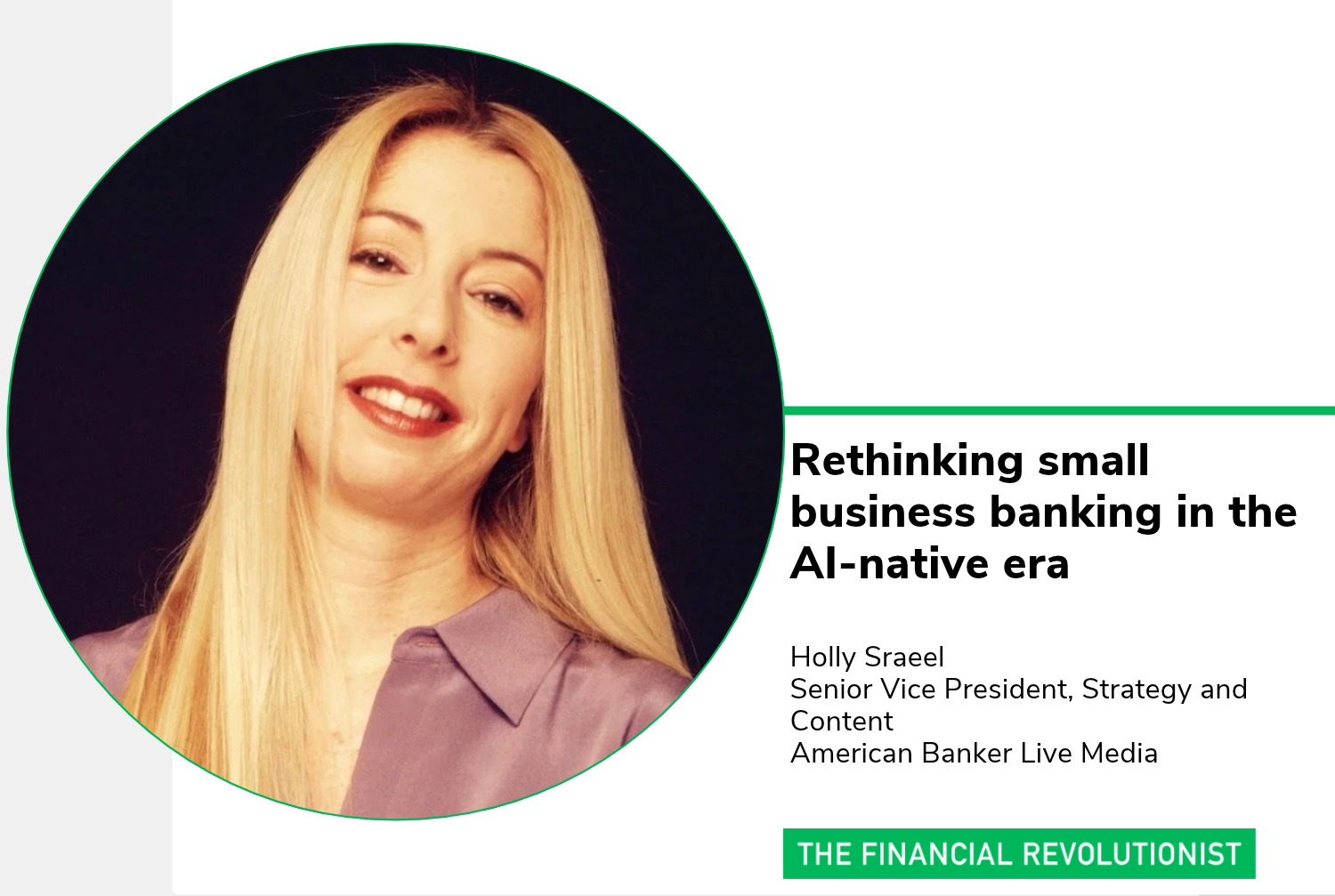
The FR recently spoke with Holly Sraeel, senior vice president of strategy and content at American Banker Live Media, to the evolving landscape in small business banking. She unpacks banks’ competition with fintechs, AI’s practical limits and the key themes for American Banker’s Small Business Banking conference, taking place Oct. 26-28 in Chicago.
Banks have long sought to become the primary financial institution for small businesses. What defines that relationship today? Is holding the checking account still a useful measure?
Holding the checking account still matters. But it just doesn’t tell you as much as it used to.
Look at how small businesses run now. The bank has the operating account. Payroll is with someone else. The working capital came from a fintech. Payments go through another platform. And the screen the owner looks at every morning is their accounting software, not their bank. You can hold the deposits and barely register in that owner’s mind.
So the real question is: when the owner has a financial decision to make, who do they call? Whoever that is owns the relationship. To be that institution, you have to know their cash flow, see the capital need coming before they ask, make payments painless, stop fraud before it hits them, and say something useful when it counts. Most banks aren’t doing that today.
Deposits still count. They anchor the relationship, and they show you how the business really operates. But if the customer lives somewhere else all day, the bank holding the account becomes plumbing—necessary, invisible, and easy to replace.
Relationship banking isn’t dying. But the banks that keep defining it as “we hold the account” are going to lose it to the companies that are actually useful.
Where are banks and credit unions falling short in serving small businesses, and what have fintechs demonstrated that traditional institutions should learn from?
Fintechs proved something banks should have known already: small business owners care a lot about speed, simplicity, and knowing where they stand.
Banks and credit unions should be winning this. They have the trust, the customer relationships, the balance sheets, and the regulatory know-how. Community banks and credit unions also know their local markets better than anyone. But you’d never guess any of that from the customer experience—at least in most cases.
Imagine a small business owner who can apply for a product online in ten minutes, get a clear answer fast, and know exactly what happens next. Then they go to their bank, and it’s multiple forms, multiple systems, and days of waiting with no idea where things stand. That’s a losing proposition for banks, and they know it.
Fintechs also figured out that you go to the customer. They show up inside the accounting, payroll, payments, and e-commerce tools the owner already uses. Banks still expect the owner to leave their workflow and come to them. Small businesses won’t keep doing that.
Banks don’t need to become fintechs. They need to stop making customers deal with their internal complexity. Nobody running a business should have to understand your org chart to get a loan.
The opening is still there. Fintechs are good at speed and convenience, but most of them still can’t deliver trusted advice or a relationship that lasts years. A bank that can match their speed and also offer those two things wins. A bank that can’t match the speed won’t get the chance to offer them.
Where is AI producing measurable improvements in small business banking, and where is the promise still ahead of the results? What has proved hardest to move beyond the pilot stage?
AI is paying off by handling necessary, though laborious grunt work, processing tons of data faster and putting better information in front of the person making the decision.
Underwriting is the obvious example. AI can pull apart financial and cash-flow data, spot patterns, and automate a lot of the review work that used to eat up hours of someone’s time. That’s real, and it’s working.
Relationship management is the other one. A banker can walk into a customer conversation with the account activity already summarized, likely needs already flagged, and a suggested next step ready to go. That means less time digging for information and more time actually advising the customer. Fraud detection, customer service, and cash-flow forecasting are delivering too.
Where the hype outruns reality is the pitch that AI can replace the judgment behind a complex financial relationship. It can’t, at least not yet, and anyone selling that story is getting ahead of the results.
Building a demo is the easy part. Anyone can show a tool doing something impressive in a pilot. The hard part is wiring it into the bank’s existing systems, controls, and workflows, and then getting employees to trust it enough to actually use it every day.
That’s where most of these efforts stall. A pilot that impresses a room is one thing. A tool that runs every day across thousands of customers and holds up to compliance, fair lending, and governance scrutiny is a completely different problem. Most institutions haven’t solved it yet.
As accounting, payroll and payments platforms add financial services, should banks compete to own the customer relationship or focus on providing the underlying banking services? What determines which approach makes sense?
There’s no single right answer here. Some banks should absolutely fight to own the relationship. If a small business is core to your strategy, your brand means something to customers, and you’ve actually invested in the digital experience, then go for it. You have a real shot at becoming the place in which small business owners trust their financial lives.
But most banks don’t need to own every screen the customer looks at. For a lot of institutions, the smarter play is supplying the regulated pieces—the lending, payments, and infrastructure—through the platforms that already have the customer’s attention. There’s nothing wrong with that. It can be a very smart business.
If you’re the balance sheet behind someone else’s product, you don’t own that relationship. The platform does. Plenty of banks haven’t accepted that yet.
Deciding which way to go comes down to a few honest questions. Where do you have an edge, not where you wish you did? What do customers expect from your brand? What can you realistically build and keep up? And how much of the customer relationship are you willing to hand to a partner?
Embedded finance is forcing those decisions whether banks like it or not. The worst place to land is the middle—supplying the product behind someone else’s brand. You’re no longer the primary bank relationship at that point.
What still slows small business lending, and which of those obstacles can technology realistically address? Where do faster decisions create new risks?
The biggest thing slowing small business lending is still information. Small businesses don’t produce the tidy, standardized financials lenders want. Revenue swings month to month. The records are scattered across accounting software, bank accounts, tax returns, and payment platforms. A business can be perfectly healthy and still look like a mess to a traditional underwriting process. That’s the lender’s problem, not the borrower’s, but it’s the borrower who ends up waiting.
Technology can fix a lot of that. Connect directly to the accounting, payments, and transaction data, and most of the document chasing goes away. Automated underwriting can work through that information in a fraction of the time. AI can flag the patterns and exceptions that need a human, so nobody has to grind through every page of every file by hand.
But faster can’t mean sloppier. When you squeeze a decision from days down to minutes, you also squeeze out the time to catch fraud, understand an unusual situation, or question numbers that don’t add up. Alternative data and algorithmic decisions also bring hard questions about explainability, governance, and fair lending. Some lenders are moving fast without good answers to those questions, and that will catch up with them.
The goal isn’t the fastest decision. It’s the fastest decision you can actually stand behind. That matters because small businesses do need more access to capital. But access that blows up in a downturn or a fair lending exam doesn’t help anyone. If you can’t do it sustainably, you’re not expanding access. You’re just taking on risk you don’t understand yet.
What unresolved issue deserves more attention at SMALL BUSINESS BANKING this year, and what would you like to see institutions do differently after the event?
The issue that doesn’t get enough attention is who actually owns the small business relationship now that financial services are splintering across a dozen providers.
We treat lending, payments, embedded finance, deposits, fraud, and regulation—and how AI is affecting all of them—as separate topics with separate panels. They’re not separate. They’re all pieces of the same strategic question, and most institutions haven’t answered it.
Small business owners don’t want 10 disconnected financial products. They want someone who makes the financial side of their business easier: managing cash flow, getting paid, accessing credit and capital, preventing fraud, and making better decisions. Pulling all those pieces together in a way that’s useful is where the competition is.
That’s why this year’s agenda at SMALL BUSINESS BANKING covers so much ground: AI in underwriting and relationship management, embedded finance, payments, deposits, fraud prevention, SBA lending, credit union strategy, underserved entrepreneurs, and regulatory readiness. These are many topics driving one conversation.
What I’d like attendees to do afterward is make decisions, not just fill a notebook with ideas. Decide which relationship you actually want to own. Pick the two or three customer problems you’re genuinely better positioned to solve than anyone else. Then be honest about whether you need to build, buy, or partner to solve them.
Small business banking is too competitive now for anyone to dabble in everything. The institutions that know exactly where they create value, and execute on it, will pull ahead. The ones trying a little bit of everything are going to get beaten in every category by someone more focused.