How one fintech made AI part of every employee’s job
/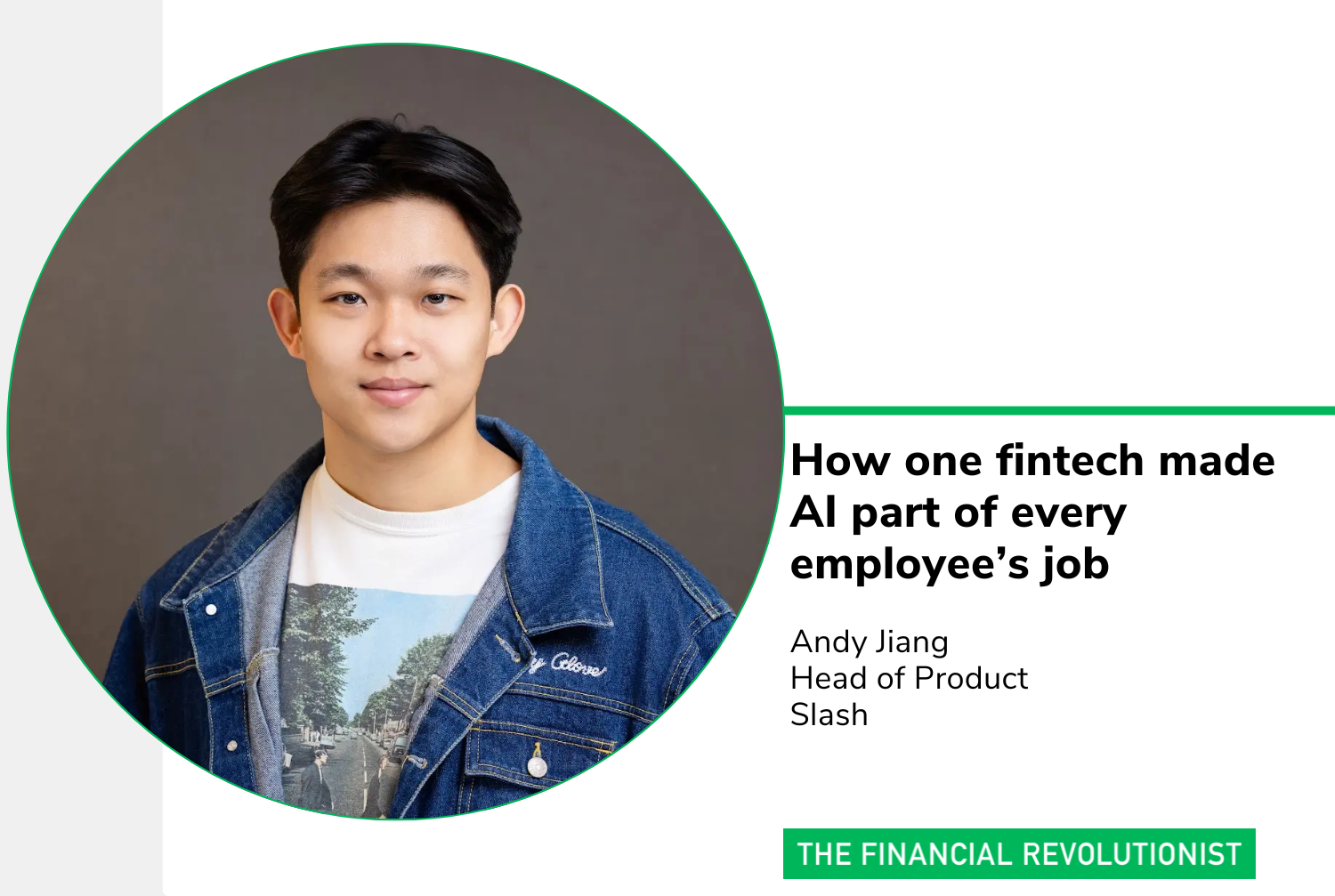
The FR sat down with Andy Jiang, head of product at Slash, to discuss how the provider of business banking, corporate cards, treasury and expense-management tools gives employees broad freedom to use AI while keeping spending guardrails in place.
Slash takes an AI-first approach to how it operates, giving employees the freedom to use AI the way they wish. What does that mean for employees’ day-to-day use of AI, and what guardrails remain in place?
Of course, we have an open approach, but it isn't without guardrails. Everyone on our team uses AI to take busywork out of their day, whether it's an engineer, a member of the sales team, or an office manager. There's no hard cap on token usage, but there are guardrails around spending.
We recently made a change to Twin, our in-house AI agent, to mitigate this. It now shows how much a session costs next to messages, so employees have better visibility into their token spend. Lightweight usage of Twin is a few cents to a dollar for a session. Twin can switch between AI models on its own depending on the type of question it receives, which cuts down token costs.
Since we're a financial company that builds tools for expense management, we have useful features for tracking spending. Every employee's spend is tracked in our own token dashboard displayed in the office. If we needed to, we could issue individual cards to every employee with a preset weekly limit tied to their AI bill. As of now, that isn't necessary, and the net benefit of relatively unrestricted usage outweighs the downsides.
As other companies are restricting AI use because of rising costs, why is Slash’s approach more open?
Slash's business model is possible because of AI. Everyone at the company is technical, independent, and trusted to build things on their own to make their job easier. Because of how much emphasis we put on automating away the work that would slow us down, we're able to offer some of the strongest unit economics in the fintech industry.
Other fintechs may require you to make a large deposit or charge management fees to offer the treasury yield and cashback that we offer. We're able to make our offers without those added requirements because our team is much smaller than those of our competitors, so our overhead is low. We hire talented people who aren't afraid to step out of their comfort zone to use AI for their work, and that combo has enabled us to build an excellent product with fewer than 20 engineers.
How much is Slash spending on AI tools and tokens, and how has that spending changed over the past year?
We're consistently doing over $200,000 a month in AI spend. It's steadily increased over the last year.
Ever since the launch of [Claude] Opus 4.5, we've seen a dramatic increase in the number of pull requests in our GitHub from every department in Slash. The quality of output is good enough that everyone feels comfortable using the tools and engaging with code, even if they don't have a technical background. The increase hasn't been a result of a few power users on the engineering team, but more so a result of the democratization of coding and automation across our team.
What measurable productivity gains, cost savings or product improvements have you seen?
We had over 5,000 more merged PRs in the last 12 months than in the prior 12 months with essentially the same-sized team. We’re shipping faster, shipping more, and doing it with fewer people than anyone else.
There have been impressive projects handled by one person that would normally require an entire team. For example, our engineer Sam built the new Slash mobile app himself. He built it from the ground up over the course of a month or two, and has created every update since. Another engineer, Gerry, built our entire invoicing suite in about a week.
Slash is one of the few startups at our stage of growth to be profitable, and it's because of this one-person-team approach. We've added 20 employees and a lot of AI bills to our books in the past 9 months, but we're still in the green because of how efficiently we're able to run things. It goes far beyond cost savings and product improvements. Efficiency is the foundation for everything at Slash — our growth would not have accelerated so quickly without the strides we’ve made integrating AI into our operations.
How does Slash prevent wasteful usage and address security, privacy and compliance risks when employees use AI?
Slash gives employees secure ways to use AI while keeping visibility into how it's used and what it costs.
Usage is tracked centrally across the company, which lets us spot waste. It also allows us to choose cost-effective models, and rein in expensive workflows as needed. Sensitive or regulated information is kept out of unapproved tools, and access to company systems follows existing permissions.
AI supports our employees rather than replacing their judgment. We always review the output and remain responsible for any consequential customer, financial, legal, or compliance decision.
What would cause Slash to reconsider its approach and impose limits on token usage?
If the economics didn't make sense anymore. If we hit a ceiling where token costs started outweighing our ability to offer strong rewards to our cardholders, or if we found we'd get more productivity by throwing headcount at a problem, then we'd cut down.
We're not going to recklessly continue using AI if it starts to sabotage our business, but we don't see that as a likely outcome.
We're always keeping tabs on new ways to stay efficient: switching between models for different queries, running smaller in-house models tuned to our needs, using Slash's expense management controls to cut down on spending. But that's all hypothetical. For now, the level of spending we're doing makes sense, and we'll adjust accordingly if needed.