AI’s critical advantage is faster decisions, not fewer humans
/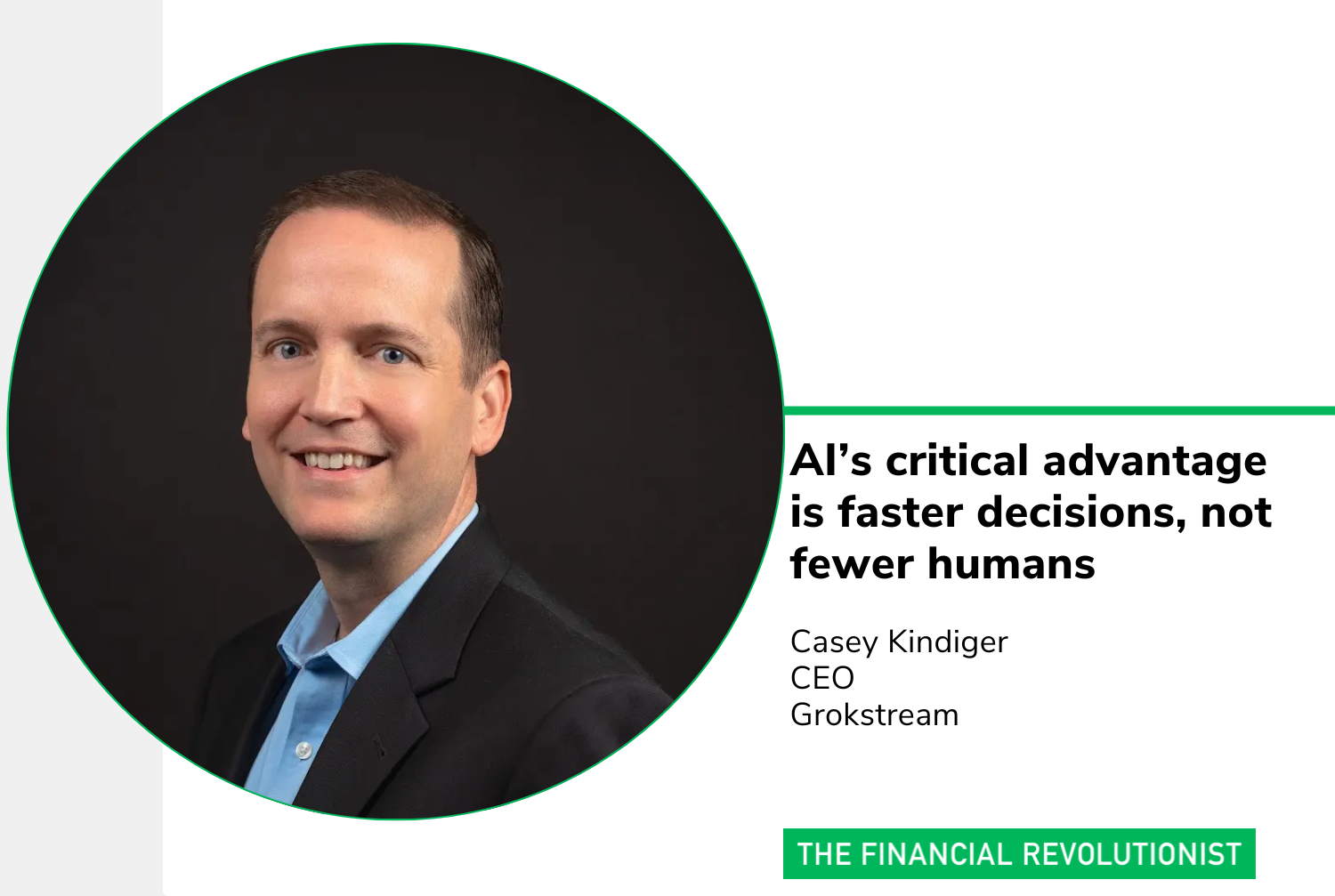
Casey Kindiger is founder and CEO of Grokstream, an AI platform that helps businesses detect, diagnose and prevent IT disruptions.
Every minute of downtime in a digital banking platform, payment network, or trading environment carries consequences. Transactions fail, customers grow frustrated, and companies lose money. The next competitive advantage won't come from detecting failures faster, but from making better decisions faster.
Financial institutions have invested billions in tools to monitor their systems, guard against cyberattacks and fraud, and automate more of their operations. Yet when a major technology disruption occurs, institutions often know something has gone wrong but struggle to determine the best response.
AI could help institutions respond faster, but only if they establish clear limits on the decisions it can make. The goal is not to remove people from the process, but to reserve their attention for calls that require human judgment.
That challenge is becoming more urgent as artificial intelligence evolves from recommendation to decision-making.
The financial services industry is entering a new era of AI adoption. Banks and fintechs already rely on machine learning to detect fraud, evaluate credit risk, optimize trading strategies, and personalize customer experiences. The next generation of AI, often described as agentic AI, introduces something fundamentally different: systems capable of reasoning, planning, coordinating actions, and pursuing objectives with increasing independence.
Gartner predicts that by 2030, 70% of finance functions will use AI to help make decisions in real time, with agentic AI making some operational decisions autonomously. As AI takes on a larger role, financial institutions will need to determine how those decisions are governed.
How much authority should financial institutions give AI? I believe that question will define the next decade of financial technology.
The shift from automation to decision-making
For years, organizations have measured AI success by automation. Could software reduce manual work? Could it execute repetitive tasks? Could it accelerate existing workflows?
Those goals remain important, but they no longer define AI's greatest opportunity. The next generation of AI is moving beyond automating tasks toward supporting, and in some cases making, operational decisions.
Consider the operational activity of a modern payment platform. Typically, performance begins degrading during peak transaction volume. While infrastructure monitoring detects elevated latency, fraud systems observe unusual transaction behavior, security tools identify suspicious network activity and customer service experiences a surge in support requests.
Each platform generates valuable information, but they don’t understand the entire situation. Operations teams must rapidly assemble context from dozens of independent systems before determining whether the issue stems from fraud, infrastructure failure, a software deployment, third-party connectivity, or an emerging cyberattack. During that investigation, every minute increases customer impact.
AI changes the equation not by replacing human expertise, but by compressing the time required to understand complex operational situations.
AI or human?
Much of the current conversation assumes a binary future: either humans remain in complete control, or AI becomes autonomous. The reality is likely to look different.
Financial institutions have always delegated different levels of authority to technology. Algorithmic trading systems already execute transactions within defined limits, fraud platforms routinely decline transactions, credit models recommend lending decisions for human review, and cybersecurity platforms quarantine compromised devices before analysts intervene.
The defining question isn't whether AI can make decisions. It's which decisions institutions are willing to trust AI to make. Rather than thinking about AI as autonomous or non-autonomous, organizations should think in terms of graduated operational authority.
Low-risk, highly repetitive operational decisions may eventually become fully automated. Higher-risk decisions affecting customers — those that involve regulatory compliance, financial exposure, or systemic stability — will likely require human intervention or approval, even as AI provides increasingly sophisticated analysis.
As confidence grows, AI may automate well-defined operational tasks with human approval. Only after consistently validating outcomes should AI earn broader operational authority.
This progression mirrors how trust develops between people. Responsibility is earned and not assumed.
AI should expand human capacity -- not replace human judgment
One misconception surrounding AI is that autonomy requires removing people from the process. I would argue the opposite is more likely. As AI assumes greater responsibility for routine operational decisions, human expertise becomes more valuable, not less.
Technology leaders should spend less time piecing together alerts and evidence, while fraud and operations teams should be freed from routine reviews and predictable incidents.
Experienced professionals can then spend more time on complex decisions that require judgment and an understanding of the broader consequences. The best uses of AI will give people a more important role, not remove them from the process.
Governance as a differentiator
This is where the discussion shifts from artificial intelligence to institutional responsibility. Financial services organizations have never adopted technology based solely on capability; they adopt it when governance matures alongside innovation. Cloud computing became mainstream only after institutions developed stronger security models. Digital banking accelerated only after identity verification, encryption, and regulatory oversight evolved. Artificial intelligence will follow a similar path.
AI capabilities will continue to advance faster than trust in them, making governance central to adoption. The institutions that succeed will be those that set clear limits on what AI can decide and ensure its actions can be understood, reviewed and reversed.
This shift is already reflected in global regulation. The European Union's AI Act introduces risk-based obligations for AI systems, while banking regulators continue expanding expectations around operational resilience and model risk management. Governance cannot be added after deployment; it must be designed into the system from the start.
In highly regulated industries, accountability is every bit as important as intelligence.
Toward responsible autonomy
AI will undoubtedly change financial services. The institutions that lead will not necessarily have the smartest AI, but they will earn trust by setting clear limits on its use and preserving human accountability.
The conversation should not focus on replacing human decision-makers, but on designing systems that pair machine speed with the human judgment and accountability financial services requires.
Ultimately, the future of AI in financial services will not be defined by how autonomous systems become, but by how responsibly institutions deploy them.