How banks are turning legacy planning into lifelong loyalty
/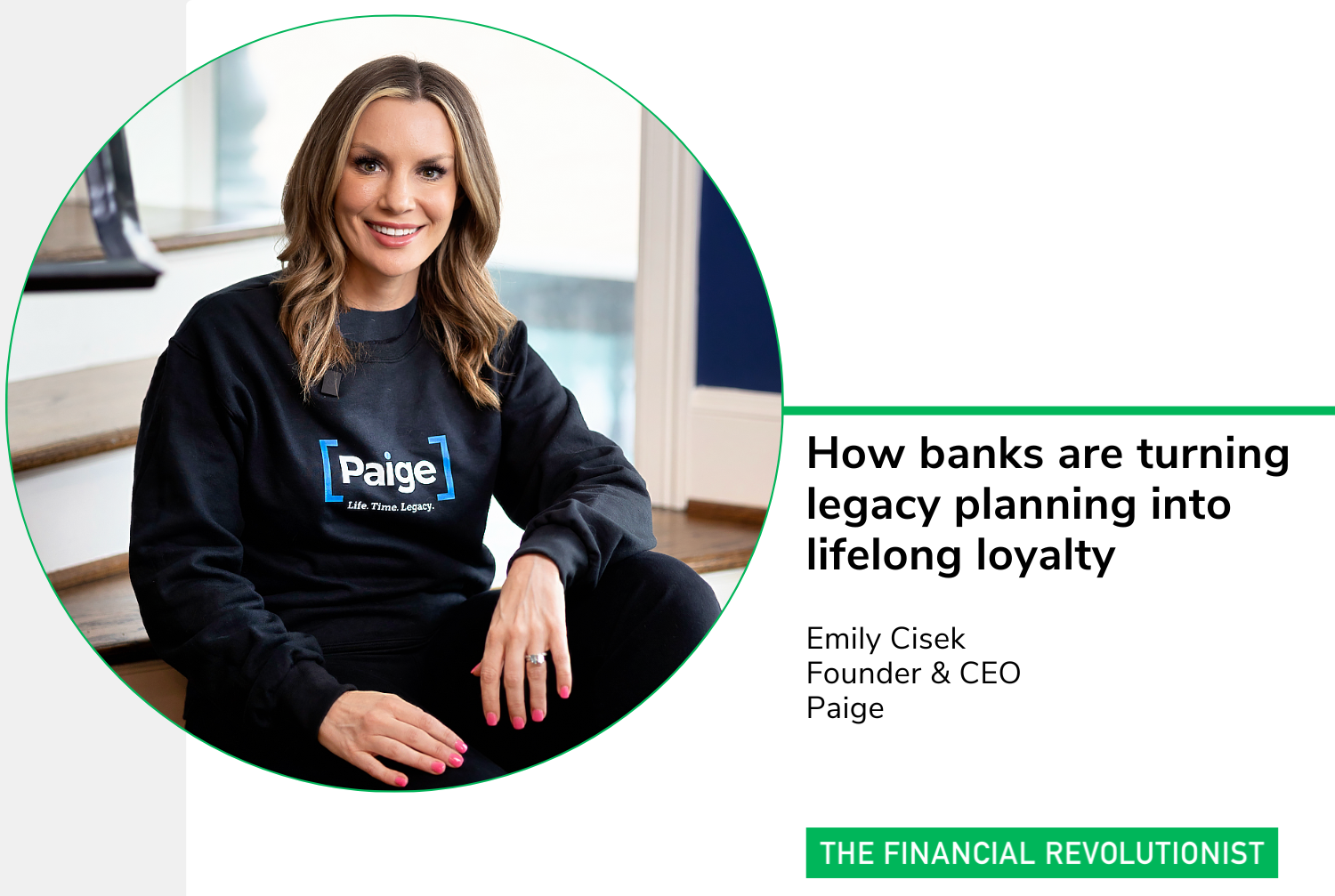
Emily Cisek is the founder and CEO of Paige, a digital legacy planning platform that partners with community financial institutions across the country to help families plan, organize, and protect their futures.
Community banks have always understood something the rest of the industry is still trying to engineer: that the relationship is the product. They know their customers by name, know their families, and have earned trust over decades that no acquisition campaign can buy.
That depth is their most valuable asset, and a growing number of community banks are now putting it to work in an unlikely place: legacy planning.
They are giving customers a way to get their affairs in order while they are living, so their loved ones are not left to reconstruct a financial life from scratch. It turns out to be one of the stickiest relationships a bank can build.
Legacy planning is emerging as an unexpected way for community banks to deepen customer relationships at a time when deposits are harder to win and banking interactions are increasingly digital. By helping families organize one of life's most emotional and complex financial moments, banks can strengthen trust, engage multiple generations, and create loyalty that extends well beyond a single account.
As fewer of those conversations happen in person, the challenge for financial institutions across the board has been how to build impactful customer relationships in the digital spaces where they spend most of their time.
Where trust meets opportunity
The opportunity is enormous, and chances are it’s already impacting your customers. AARP and the National Alliance for Caregiving report that there are 63 million family caregivers in the US, up 50 percent since 2015. Nearly a third are caring for children and aging parents at the same time.
These are the people at the center of the wealth transfer, holding responsibility for a parent's estate in one hand and their own children's future in the other.
Three out of four Americans don't have a will, according to Caring.com. For an institution a family already trusts, that is an open door to show up for the caregiver navigating it all right now, and to connect with three generations at once.
The relationship competitors can't buy
For the banks already doing this, legacy planning has become a way to make their relationship promise tangible. In my own work, I've found this works best when the buy-in starts inside the bank, before it ever reaches a customer.
One community bank in the Midwest rolled out its new digital legacy planning feature to employees first. Within the first week, employee activation reached 70%. By the time customers began using the platform, frontline staff could answer questions from firsthand experience rather than relying on training materials. In Texas, a regional bank serving rural communities saw the same pattern hold, proof that the approach travels beyond any one market.
The higher employee engagement is, the better staff become at using these tools to reach customers. It opens new touchpoints by guiding people through onboarding, helping them think through what to include in their plans, and even hosting scanning events where customers digitize and share important documents with their loved ones.
This kind of voluntary adoption is its own signal. By becoming advocates in the legacy planning process themselves, employees can encourage customers to move from intention to action, in a space where too many people do nothing. That gap is where long-term loyalty is won.
Loyalty that compounds
Show up for people when it counts, and the business follows. None of this is a new idea. What is new is a realistic way for FIs to act on it. Legacy planning opens conversations a bank welcomes, around deposits, succession, and the accounts the next generation is beginning to build, and those conversations tend to naturally create a network effect as family members are brought into the mix.
It is also a relationship with staying power. Legacy planning is not a one-time sale but an ongoing service with built-in renewal, and the platforms leading this space report 99 percent user retention. A customer who has organized their entire financial life with their bank has every reason to stay.
The upside without the overhead
A community bank does not need to become a technology company, or a law firm, to do this well. The bank's role is simply to help customers get organized, not to wade into the legal or compliance side of estate planning.
The digital tools emerging now do the heavy lifting, replacing scattered physical paperwork with a single secure place a family can actually find when the moment comes.
By partnering with fintechs, the bank can offer all of this under its own brand without adding operational weight or pulling its teams off other priorities. The bank stays the trusted face while the fintech handles everything in the background.
For banks searching for new ways to connect with customers, implementing legacy planning tools is a rare strategy that is low risk to stand up and built to scale.
Where relationship banking delivers
The first chapter of the wealth transfer story was about capturing assets in motion. What's being written now is about being there for the families thinking about how they’ll move them. Get that right, and a bank is no longer serving one customer. It is serving three generations of the same family, and earning the next one before it ever walks in the door.