AI won’t replace the advisor growth playbook
/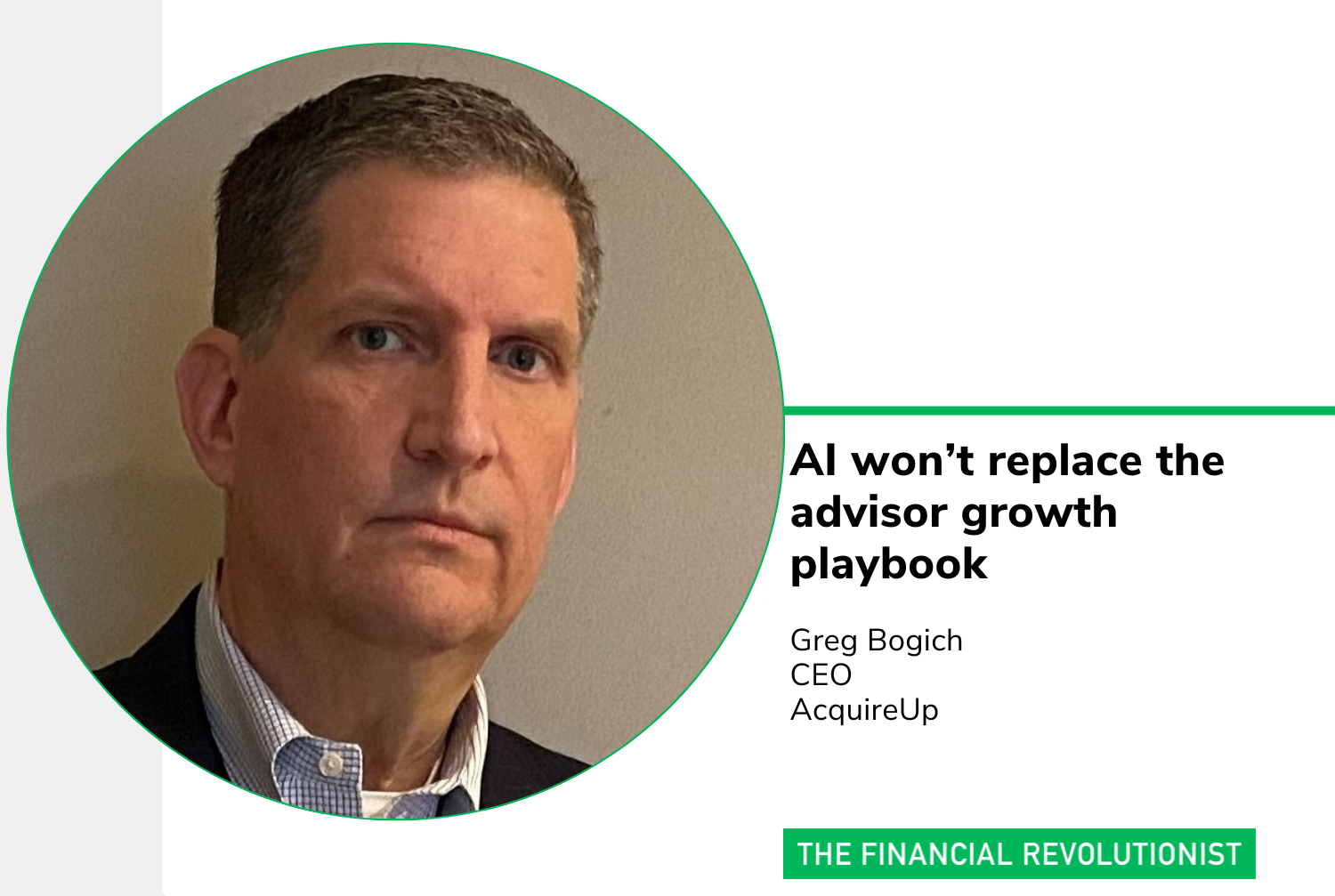
Greg Bogich is CEO of AcquireUp, a seminar marketing company for financial professionals.
AI isn’t supplanting financial advisors. When it comes to growth, in-person interactions, conversations and referrals drive the most value. But AI can free up advisors to increase their impact.
In 2026, financial advisors are constantly looking for reliable growth tactics; but with organic growth averaging just 2–3%, the real challenge is finding proven marketing channels that are consistent and repeatable systems. While AI and automation are becoming essential for efficiency, data shows they are most valuable when used to protect and prioritize human connection, not replace it. The firms ahead are the ones using AI to remove friction and double down on trust.
Our latest research shows that although advisors are increasingly adopting AI, most new business still comes through relationships, particularly referrals and networking. The opportunity is to use AI behind the scenes to make those channels more reliable sources of growth.
Findings from AcquireUp’s most recent Industry Index show that if 2025 was about adaptation and integration of new technology, 2026 is the year firms start optimizing and refining operations. More than half of advisors said they use AI and other technology tools to increase efficiency, while 34% are conducting more of their business virtually than in the past. Taken together, these data points show that advisors have successfully integrated technology to reach more clients and scale the value they deliver within existing relationships.
The task for advisors going forward is building on what works. That doesn’t necessarily mean adding more channels or complicating their technology stack. A third of advisors said they were working on plans to grow their businesses. They also noted that they struggled with having lean teams and even leaner marketing budgets.
Given that reality, the takeaway is that most advisors don’t need more tools. They need a consistent growth engine around the channels that produce the greatest results. For solo advisors or small teams where every marketing dollar is personal, that cadence is what turns a string of one-off campaigns into growth that’s reliable and scalable.
Advisors report that even with new technology, the bulk of new growth is coming from referrals, seminars and existing relationships. AI and other tools can support these efforts, but they aren’t yet overtaking them as primary drivers of business growth.
AI is becoming useful, but mostly behind the scenes
For all of the hype around AI as a transformational technology, the reality is more measured.
To be sure, AI adoption is increasing among advisors, with 17% reporting they are very familiar with AI and use it often, while 40% say they are somewhat familiar and use it occasionally. Another 28% have only heard of AI tools and want to learn more, signaling that the majority of the industry is still in early or exploratory stages of adoption.
Where adoption is growing, it’s still concentrated in practical, support-oriented functions. Advisors are most likely to consider using AI for tasks like marketing (43%) -- primarily content creation, social media and emerging areas like search and answer engine optimization – alongside client communication (49%) or report writing (33%). Fewer are applying it to more complex or regulated areas like portfolio management (25%) or compliance and risk (24%). So AI is best at handling low-stakes repeatable tasks, freeing up time for higher-value work like relationship building.
At the same time, adoption is tempered by clear hesitation. More than half of advisors cite concerns around accuracy (65%) and compliance (55%), with additional concerns around privacy (51%), cost (29%) and complexity (27%).
Human connection drives results
Nearly half of advisors say that networking and referrals from existing relationships drive the bulk of new business growth. However, more than half (52%) report not having any formal referral systems in place. That's a gap worth closing. Advisors who build even a basic tracking system for referrals, with AI handling follow-up cadencing and reminders, can turn what is mostly a lucky break into something they can count on repeating.
Seminars are another option advisors can use to support networking and relationship building. 47% of advisors say managing client expectations is one of their biggest challenges, and 42% cite helping clients avoid emotional reactions to markets. While these issues typically surface after onboarding, seminars allow advisors to address them earlier in the funnel by educating prospects and setting expectations before they become clients, positioning advisors as trusted guides from the outset.
Advisors often treat seminars as a one-off event, but they can be leveraged as a repeatable growth system that helps bring in new business while offering education and support to existing clients.
Seminars offer an opportunity for valuable thought leadership and education on key investing topics. When approached systematically, they can also generate a reusable content library, as materials created for events can be repurposed into client-facing education, ongoing communications, and follow-up engagement that helps advisors stay consistently in front of both clients and prospects.
AI can then support these efforts by automating follow-ups, guiding attendees to additional resources and helping advisors track client interactions. For the operations or marketing leads running these programs day to day, the right tools can take the coordination weight off their plate and make an ongoing seminar cadence feasible instead of exhausting.
A hybrid future
AI isn’t replacing advisors anytime soon. By moving to a hybrid growth model, where AI acts as a force multiplier by taking over low-stakes administrative functions, advisors can focus on high-value client interactions and relationship building.
Advisors can also use that excess capacity to build consistency by turning their highest-value activities, seminars, networking, and education, into repeatable growth systems, supported by automated follow-ups and onboarding funnels that keep opportunities from slipping away. For growing firms, the next step is obvious: run that engine across the whole organization so growth doesn’t depend on any one advisor showing up.
In a more automated industry, human connection isn’t diminishing. It’s becoming more intentional, more scalable, and ultimately, the true differentiator.
Hunter Washington, financial and wealth advisor at InvestWise Financial, contributed insights to this article.