Why the correspondent clearing model Is failing the next generation of broker-dealers
/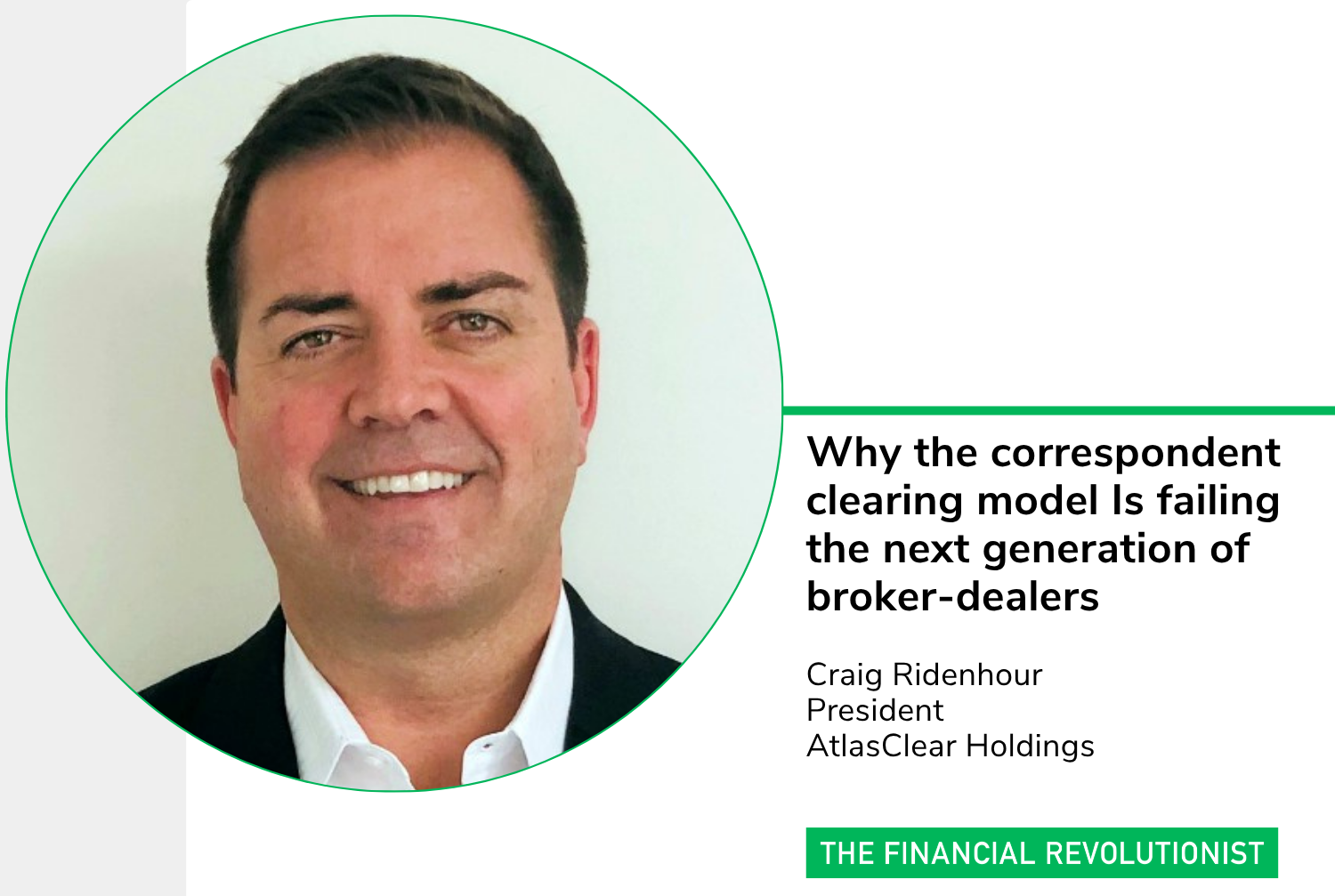
Craig Ridenhour is president of AtlasClear Holdings, a firm building modern correspondent clearing and custody infrastructure for broker-dealers and fintech trading platforms.
I have spent years inside the machinery of correspondent clearing. I know what it looks like when a firm that should be a client gets turned away, not because of credit risk or regulatory standing, but because its transaction profile does not fit the legacy model’s assumptions. That happens more than the industry likes to acknowledge.
A new generation of broker-dealers and fintech trading platforms has entered capital markets over the past several years. They are well-capitalized, well-regulated, and technologically sophisticated. Many cannot get cleared. Those that can often do so on terms that compress their economics before they have processed a single trade. That is a structural problem, and it is getting worse.
The issue is not demand or capability. The clearing infrastructure broker-dealers depend on was built for a different market. As trading models evolve, that mismatch is becoming a structural constraint on who can scale, on what terms and how quickly.
The model has a profile problem
Correspondent clearing works by allowing smaller broker-dealers to outsource clearing and settlement to a larger firm. The economics make sense for firms that match the incumbent’s assumptions: conventional equity flows, predictable volumes, limited asset complexity and enough transaction revenue to justify the relationship.
The next generation of broker-dealers does not match those assumptions. A retail trading platform processing several million micro-transactions per day in equities and options looks nothing like a traditional regional broker-dealer from 2005. A digital asset firm with exposure across multiple asset classes presents a risk profile that legacy clearing systems were never designed to model. An API-native fintech that expects real-time data feeds and automated settlement workflows cannot function efficiently through a process that still relies on manual file transfers and end-of-day reconciliation.
Picture a fintech that launched a retail trading platform three years ago. It now processes roughly two million transactions per day across equities and options, has passed FINRA examinations without issue, and carries adequate net capital. It approaches one of the major correspondent clearing firms to expand its clearing relationship. The response is a six-week review process, a request for transaction history in a format its systems do not produce natively, and a preliminary term sheet with a fee structure built around a conventional equity commission model that bears no relationship to its actual business.
Six months later, the firm was still limping along under an arrangement never designed for its scale or growth. This is not an isolated case. It is the pattern.
Consider a second scenario: a broker-dealer building a multi-asset platform that executes equities, options and digital assets through a unified client interface. Its clearing partner can risk-manage equities in real time but has no comparable capability for the other asset classes. The result is fragmented margin requirements, inconsistent settlement visibility across the book, and capital tied up against positions the clearing system cannot accurately model. The technology works. The clearing relationship is the constraint.
Legacy clearing firms did not build the wrong system. They built the right system for a market that no longer exists.
T+1 made the gap visible
The move to T+1 settlement in U.S. equities in May 2024 was the clearest stress test the correspondent clearing model has faced in years. Compressing the settlement cycle by a full day requires tighter coordination, faster confirmation and significantly less tolerance for operational delays at any point in the chain.
For clearing firms with modern, automated infrastructure this was an operational challenge. For legacy platforms running overnight batch processes and manual exception handling, it was a genuine strain. The firms that struggled most were not the large incumbents. They were the correspondents whose clearing relationships depended on workflows that were already running without much margin for error.
T+1 did not introduce new complexity. It removed the buffer that had been masking it.
AI is raising the floor, not just the ceiling
A broker-dealer can now automate trade surveillance, margin calculations, and client reporting in real time using AI-driven systems available off the shelf. Compliance exceptions that once required manual review can be flagged, scored and escalated without human intervention. Risk positions can be monitored continuously across the entire book.
Then that same broker-dealer submits an onboarding request to its clearing firm. The process takes weeks, requires transaction data reformatted to legacy specifications, and returns a static risk model calibrated for a conventional equity book. The front office runs in real time. The clearing relationship runs on a different clock entirely.
This is not an operational inconvenience. It is a direct constraint on revenue, capital efficiency and time to market.
The irony is that AI is making it easier to build modern clearing infrastructure while simultaneously making the gap between modern and legacy more apparent to the firms living with it every day. The technology required to run real-time risk models across mixed asset portfolios, automate onboarding workflows, and deliver settlement transparency now exists and is not prohibitively expensive. The barrier to building it was never the technology. It was the regulatory standing, the capital requirements, and the organizational will to do it.
Why this matters for the market
Clearing infrastructure is invisible to end investors. It does not show up in headlines. But it determines which broker-dealers can operate efficiently, which trading platforms can scale, and which business models are viable. When clearing capacity is concentrated in a small number of incumbents with limited appetite for nontraditional clients, competition in the downstream market suffers for it.
For a broker-dealer trying to scale today, this is not an abstract problem. It shows up as onboarding timelines that delay revenue by months, pricing structures calibrated for competitors twice their size, and system limitations that cap what they can offer clients. Every quarter spent working around legacy clearing infrastructure is a quarter not spent building the business. The firms that solve this first will not just grow faster. They will structurally outcompete the ones still working around a model that was never built for them.
What purpose-built infrastructure actually requires
Building a clearing platform that serves next-generation broker-dealers is not a software project. It requires broker-dealer registration, clearinghouse membership, significant net capital, and operational capability across risk management, settlement and custody. These requirements have kept the space resistant to new entrants for decades. They also mean that firms capable of meeting them can develop genuinely durable competitive positions.
The architecture has to be different by design. Real-time inventory and risk visibility across client accounts. API-native connectivity that integrates with how modern broker-dealers actually operate. Risk models built for mixed asset portfolios, not calibrated exclusively for conventional equity flows. Onboarding workflows that compress weeks into days.
None of this is theoretical. The technology exists. The regulatory pathway exists. What has been missing is the willingness to build infrastructure for the clients the incumbents have chosen not to serve.
The opportunity
Capital markets are not short of innovation. But much of that innovation has been built on top of a clearing and custody layer that has not meaningfully evolved. As the firms building on top of that layer grow more sophisticated, the gap between what they need and what legacy clearing provides is becoming impossible to paper over.
The next generation of market participants deserves infrastructure built for where capital markets are going. The firms that build it will not just serve a gap in the market. They will help determine what capital markets look like for the next generation of participants.