How AI is remaking regulatory compliance
/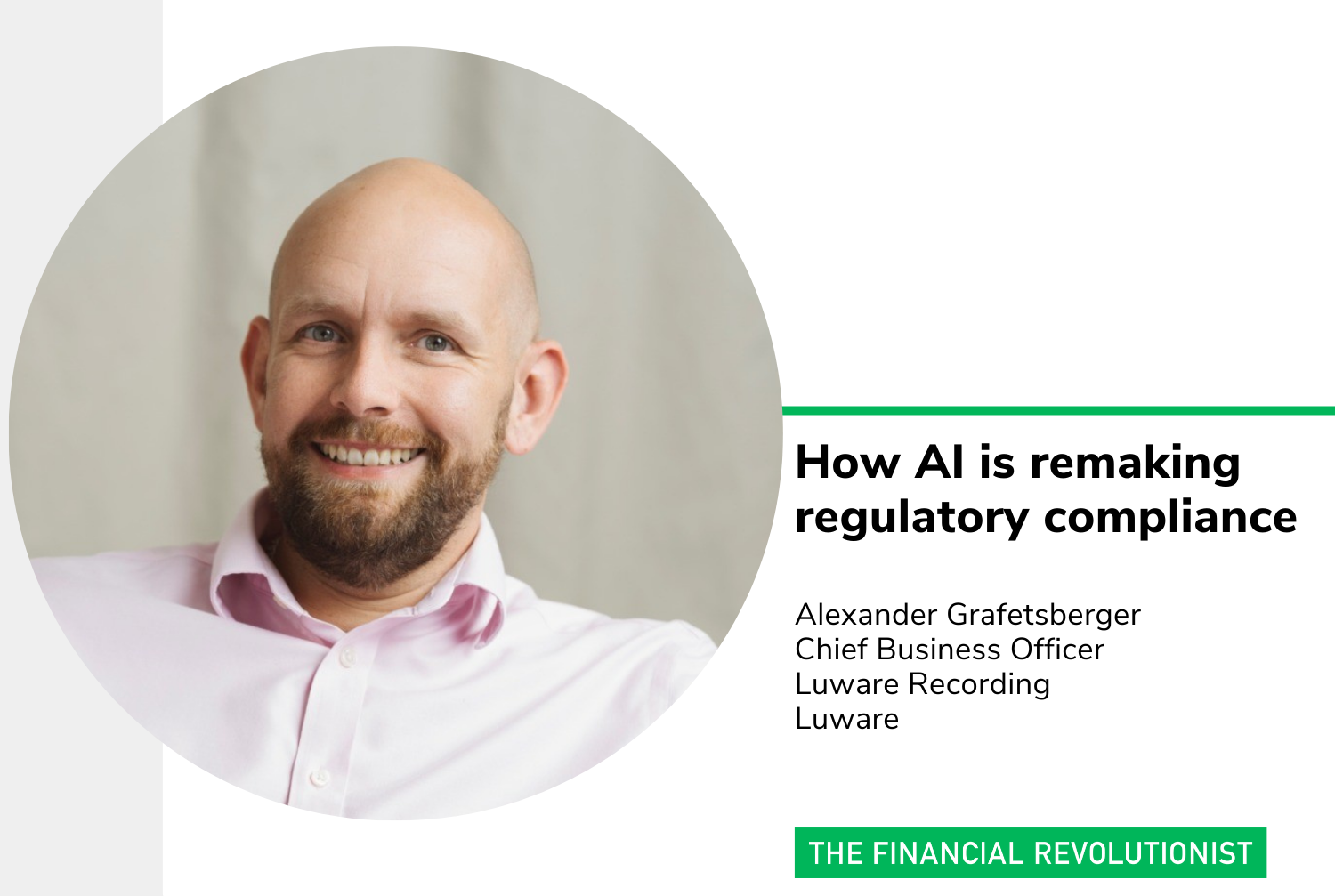
Alexander Grafetsberger is the chief business officer for Luware Recording at Luware, a software firm that lets organizations run contact-center operations in Microsoft Teams.
Financial institutions today face mounting regulatory pressure as compliance expectations continue to intensify. Regulators around the world are imposing stricter requirements on how banks, credit unions, and other financial firms monitor and record customer interactions.
In the United States, SEC Rule 17a-4 requires broker-dealers to record and preserve all communications related to customer transactions and investment recommendations, while FINRA Rule 3110 further mandates the establishment of supervisory systems to review those communications and ensure compliance with securities laws.
In Europe, the recently revised Markets in Financial Instruments Directive II (MiFID II) imposes similar obligations on European financial institutions, requiring them to record and retain all conversations and electronic communications that lead to or are intended to result in transactions. At the same time, financial institutions leveraging AI-driven tools must also ensure these systems — and their providers — comply with emerging regulations such as the EU AI Act, which sets new standards for transparency, accountability, and governance in high-risk sectors like financial services.
The goal of these regulations is clear: to detect and prevent misconduct, market abuse, and mis-selling. But meeting these demands has become a complex, resource-heavy challenge. Firms must not only capture every interaction such as phone calls, emails, instant messages, and video conferencing tools, but also store this data securely, ensure it’s easily retrievable, and regularly review it for potential compliance breaches. Failure to meet these standards can result in severe penalties, reputational damage, and a loss of customer trust, making robust communication oversight a non-negotiable element of modern financial operations.
Compliance: from burden to opportunity
Traditionally, compliance has been viewed as a defensive function: necessary, but costly and time-consuming. Compliance teams have spent countless hours sifting through massive volumes of data, audio recordings, and transaction logs, often using fragmented systems with limited automation. Legacy tools have focused on satisfying minimum regulatory requirements rather than enabling proactive risk management or operational improvement.
For instance, in 2024, the Commodity Futures Trading Commission fined a Minnesota-based futures commission merchant $650,000 for failing to maintain approximately 3,000 audio recordings of customer communications and for executing trades without proper customer authorization. This case underscores the critical importance of monitoring communications and ensuring robust recordkeeping to detect and address risky conduct before it leads to regulatory penalties.
Now, artificial intelligence is transforming compliance from a purely reactive obligation into a strategic advantage — one that enhances efficiency, drives insight, and improves client experiences.
A new approach to conduct risk
One of the most significant advances in AI-driven compliance lies in how conduct risk is managed. Traditional monitoring tools rely on keyword spotting or rule-based triggers only — approaches that often lead to high false-positive rates and missed context. Modern AI systems, in contrast, enhance these by analyzing entire conversations across voice, video, and chat channels to assess tone, sentiment, and behavioral patterns.
For example, a conversation might contain no explicit trigger phrase, yet the model identifies that an employee is discussing non‑public information in a way that implies insider trading. Advanced system implementations can even flag when such a conversation occurs, assign a categorized risk marker (“insider trading,” “policy deviation,” or “regulatory breach”) and present the exact time‑stamp of the relevant segment so investigators can swiftly review the pertinent moment rather than the entire recording.
This contextual understanding allows firms to detect misconduct such as insider trading or mis-selling with far greater accuracy. By reducing false positives — often as high as 90% in traditional systems — AI allows compliance teams to concentrate on genuine risks and respond faster, minimizing the chance of costly enforcement actions.
From hours to minutes: driving efficiency through purpose-built AI
The most effective AI solutions are those purpose-built for the regulatory, security, and operational realities of financial services. Unlike generic tools, they integrate seamlessly into existing oversight workflows, align with complex risk taxonomies, and operate within fully auditable, secure, and explainable frameworks that meet the industry’s stringent regulatory and ethical standards.
Furthermore, the impact on efficiency is profound. Tasks that once took hours or even days can now be completed in minutes. For instance, a tailored AI bot used in financial services call recording and transcription can automatically detect and flag potential risk events with contextual, intelligent alerts, helping compliance teams respond faster and more accurately without having to manually review lengthy transcripts. It can also summarize calls and meetings, track action items in real time, and enrich CRM systems with structured, high-quality data that strengthens audit trails and enhances client experiences.
Compliance as a competitive advantage
AI-powered compliance turns data into insight, risk into opportunity, and regulatory obligation into competitive advantage. Financial institutions that embrace this technological shift are better positioned to navigate uncertainty, build client trust, and maintain a leading edge in a rapidly evolving market. Compliance is no longer just a cost of doing business — it’s a driver for doing it better.