AI won’t matter until banks start measuring output
/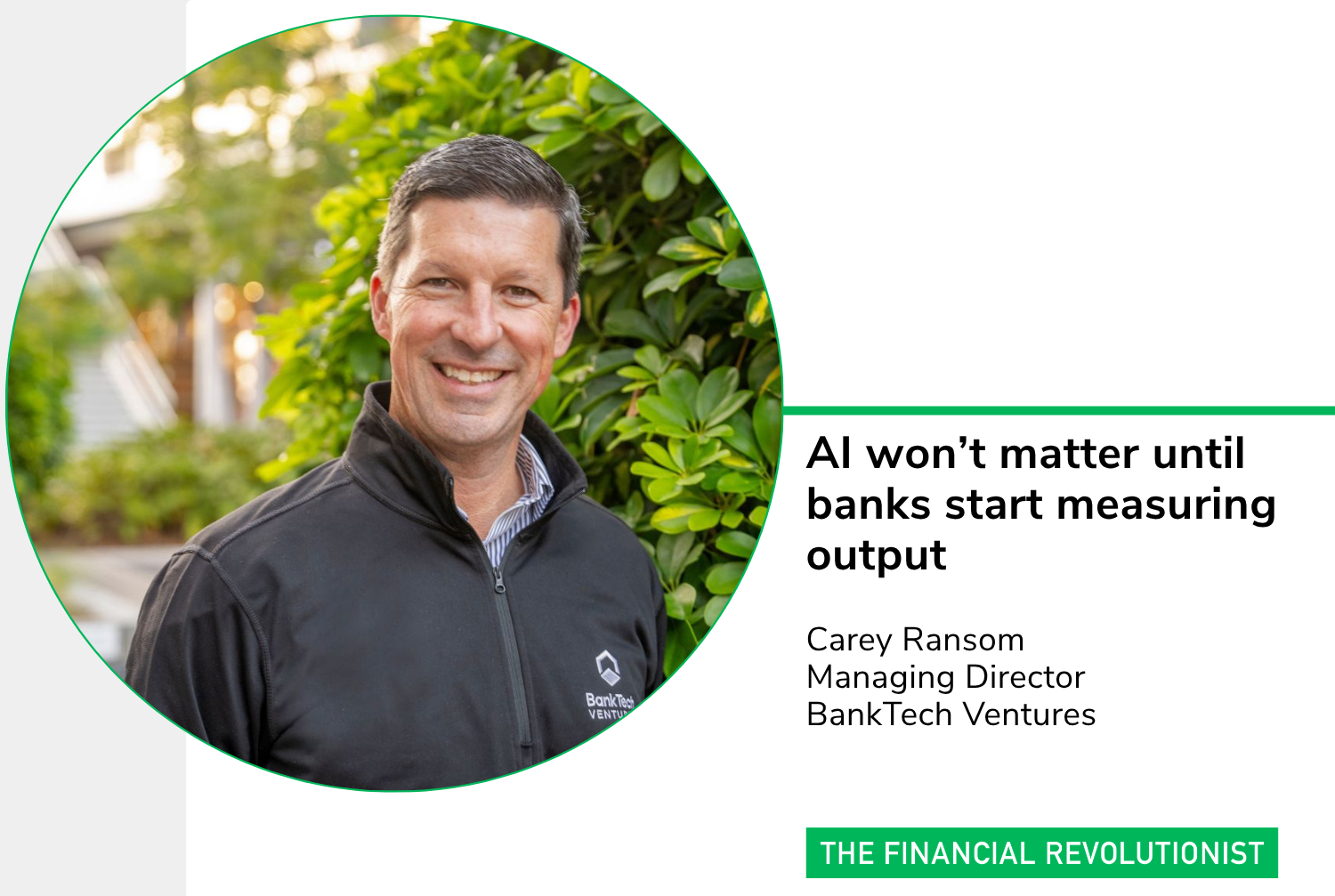
Carey Ransom is a SaaS entrepreneur, executive, investor and advisor. He is president of Operate and managing director of BankTech Ventures, a strategic investment fund focused on technologies for community banks, founded and funded by leaders in the community bank ecosystem.
I just got back from Fintech Meetup where I moderated a panel of founders building fintech companies and embracing AI agents as a key part of them. These aren't people experimenting with AI on the side. Some of them are building the company agent-first and designing their organizations around AI from day one. They’re deploying agents that replace human work, not just assist with it.
AI is changing how work gets done, but banks haven’t changed how they measure or reward it. They’re not going to move that fast, and that’s fine; the industry will be more deliberate and calculated. But the evidence is now overwhelming that new organizing structures, new incentives and new ways of measuring output are arriving whether institutions are ready or not. The winners will embrace them. That’s why new thinking about how banks evaluate and reward their people is needed more than ever.
They can buy all the AI tools they want, but if they keep measuring and rewarding people the same way they always have, change will be slow or won’t happen at all. This is where the great divergence begins.
The measurement problem
Right now, most banks measure managers the way they’ve measured them for decades. How big is your team? How large is your budget? How many people report to you? These are proxies for importance, and they’ve been baked into compensation structures, title hierarchies and promotion decisions for so long that nobody questions them anymore.
But think about what AI actually does. It makes smaller teams capable of producing the same output than much larger ones. A manager running a two-person team that uses AI to deliver the same results as a traditional 10-person team is objectively creating more value. Lower cost, same output and probably faster turnaround.
Under today’s measurement systems, that manager gets punished. Fewer direct reports means a smaller empire, which means less perceived importance, which means a lower title and less compensation. The manager running the 10-person team looks more impressive on paper, even though they’re five times less efficient.
That’s backwards in the AI-enabled world we’ve entered. And until banks start to adapt, AI adoption will stay stuck in pilot mode.
Rewarding output, not headcount
This isn’t complicated. Banks need to start measuring what actually matters: output and its productivity. What did your team deliver? What did it cost to deliver it? How quickly? How effectively?
If one manager produces excellent loan portfolio results with two people and smart AI deployment, and another produces similar results with 10 people using traditional methods, the first manager should be making more money. Period. They figured out how to do more with less, and that’s exactly the behavior banks need right now.
This isn’t about cutting jobs for the sake of cutting jobs. It’s about recognizing that the people who learn to work with AI and who figure out how to direct it, validate its output, and combine it with their own judgment are becoming exponentially more valuable. Banks need to show that with real dollars and real career advancement.
The manager of 10 is actually holding their team back, as those members could likely upskill and take better jobs at the bank. Not everyone will have the personality to switch from the back office to a relationship manager role, but they could work toward more important, higher-value roles.
Driving behavior change
Here’s why this change matters so much. Incentives drive behavior. Everyone in business knows this. It’s why commission structures exist, why bonus pools are tied to performance metrics, and why banks spend enormous energy designing compensation plans.
Yet when it comes to AI adoption, most banks are relying on encouragement. Memos from the CEO. Training sessions. Town halls about the future. That's not how you change behavior in organizations. You change behavior by changing what gets rewarded.
Banks that get this right will create a virtuous cycle. Reward AI-enabled productivity, and more managers will adopt AI. More adoption means more learning, more experimentation, and more discovery of what works. Yes, there will be mistakes along the way, and that’s what scares many banks today. Some AI-assisted decisions will be wrong. Some processes will need to be reworked. That’s the cost of learning, but it’s a lot cheaper than the cost of standing still.
The banks that don't get this right will watch their most capable people leave. The best talent will figure out pretty quickly which institutions value their ability to work smarter and which ones still just count heads. This is not a small change that's starting to play out. I'm convinced this will be the biggest change in our lifetime in how work gets done.
The coming divide
The defining split in banking over the next several years won’t be AI versus no AI. It will be between banks that redesign their structures to drive AI-powered transformation and those that bolt AI onto unchanged organizations and wonder why nothing feels different.
The first group will get leaner, faster and more competitive. Their people will be more engaged because they’re being recognized for real impact and output. Their cost structures will improve not through painful layoffs, but through natural evolution as AI-augmented teams take on more and do more for the bank and its customers.
The second group will most likely have the same org charts, the same measurement systems and the same cultural resistance, just with some AI tools sitting mostly unused on the shelf.
The technology isn’t the hard part anymore. Changing what you measure and reward is where transformation actually happens. I’m excited to be right in the middle of it and ready to help.